Agentic Commerce Is Coming to Fashion: What Happens When AI Starts Shopping for the Customer?
AI shopping agents are changing how consumers discover, compare and buy fashion. Explore what agentic commerce means for fashion brands and why product intelligence, structured data, visual content and AI readiness will become critical.
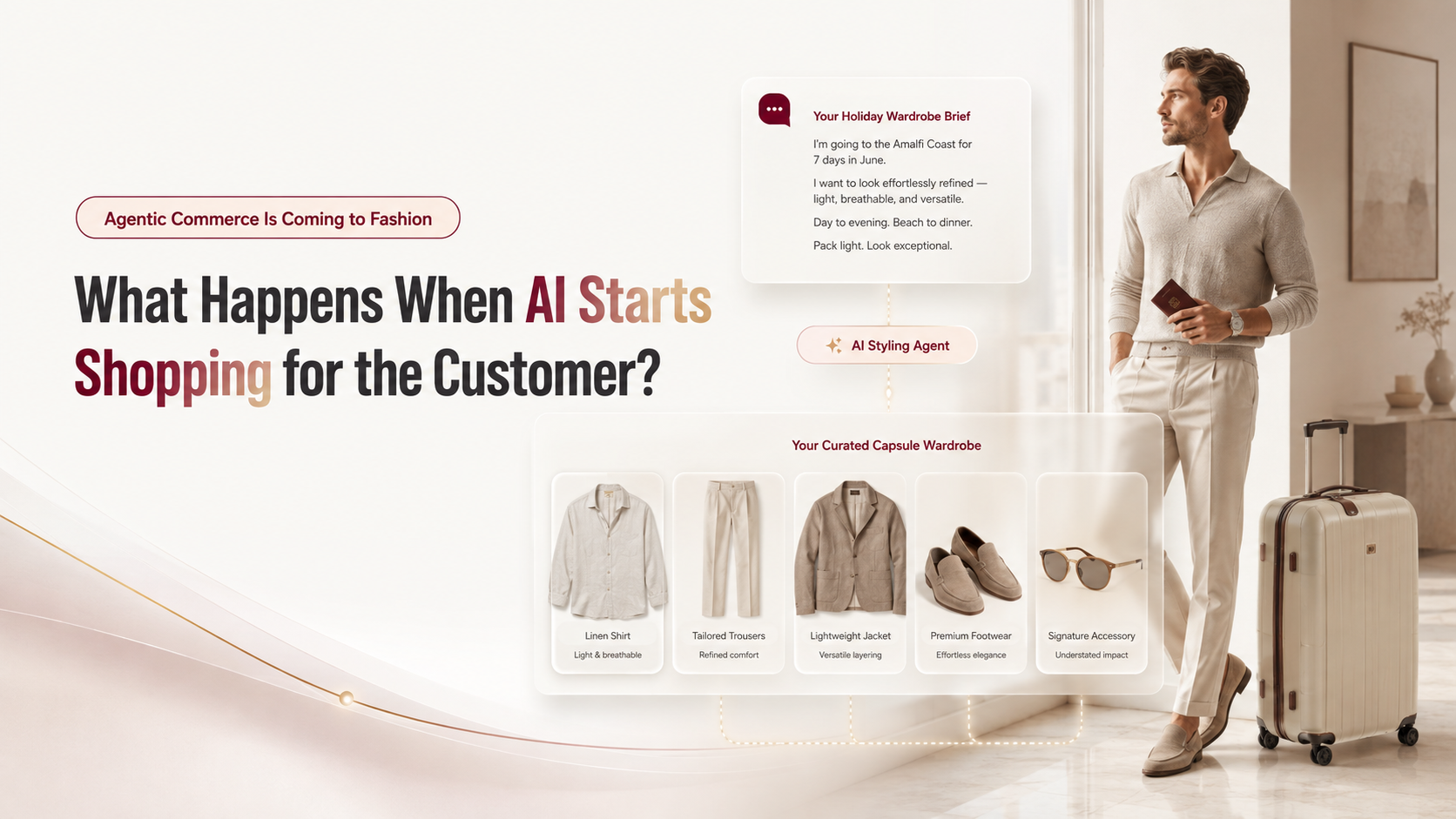
# Agentic Commerce Is Coming to Fashion: What Happens When AI Starts Shopping for the Customer?
Introduction: The Next Fashion Customer May Be an AI Agent
For most of ecommerce history, brands have sold directly to people.
A shopper searched. They browsed. They compared. They chose. They bought.
That journey is beginning to change.
AI shopping assistants are moving beyond answering questions and recommending products. They are increasingly able to research options, compare merchants, build carts and, in some cases, help complete purchases on behalf of users.
This emerging model is called agentic commerce.
For fashion brands, the implication is profound.
The next competitive battle may not simply be about convincing a person to click your product.
It may also be about making sure an AI agent can understand, trust, recommend and transact with your brand.
What Is Agentic Commerce?
Agentic commerce is a form of digital commerce in which AI agents perform multi-step shopping tasks on behalf of a consumer or business.
Instead of the shopper manually completing every step, the AI can help interpret intent, research products, compare options, narrow choices and increasingly assist with checkout.
The difference between traditional ecommerce and agentic commerce is simple:
Traditional ecommerce gives customers tools to shop.
Agentic commerce gives customers an intelligent assistant that can shop with them, and sometimes for them.
What Agentic Fashion Shopping Could Look Like
Imagine a customer saying:
“I am going to Greece for five days. Build me three outfits under $1,000. I prefer understated luxury, natural fabrics and neutral colours. I need one look for sightseeing, one for dinner and one for a beach club.”
A traditional ecommerce website cannot easily handle this request.
An AI shopping agent can break it down.
It can identify:
- The destination and climate
- The customer’s budget
- Style preferences
- Fabric preferences
- Occasions
- Existing purchase history
- Size and fit preferences
It can then search across products, compare alternatives, create outfits and explain why each item works.
The customer is no longer searching for products.
They are describing an outcome.
From Search Box to Shopping Brief
Fashion ecommerce has traditionally depended on keywords and filters.
Women → Dresses → Midi → Black → Size M
Agentic commerce changes that interface.
Customers can communicate the way they naturally think:
“I need a wedding guest outfit that does not look too formal.”
“Find a blazer that works with the trousers I bought last month.”
“Give me a capsule wardrobe for a two-week business trip.”
The AI converts messy human intent into structured shopping decisions.
That is a major change in how fashion discovery works.
Why Fashion Is Especially Suited to Agentic Commerce
Fashion shopping is difficult because customers rarely evaluate products on a single attribute.
They care about a combination of:
- Fit
- Style
- Occasion
- Price
- Material
- Colour
- Brand
- Weather
- Existing wardrobe
- Social context
That makes fashion an ideal category for AI-assisted decision making.
An intelligent agent can evaluate many variables simultaneously and reduce the effort required from the shopper.
Discovery Is Becoming an Invisible Shelf
Traditional ecommerce created a visible digital shelf.
Search results. Category pages. Marketplace listings.
Agentic commerce introduces another layer.
The AI agent becomes the intermediary deciding which products are worth presenting.
That creates what can be thought of as an invisible shelf.
If the agent cannot clearly understand your product, your product may never reach the customer’s shortlist.
Fashion brands therefore need to optimize not only for human discovery, but also for machine understanding.
The New Question: Can AI Understand Your Product?
Consider two fashion product listings.
Product A:
“Blue Dress. New Collection.”
Product B:
“Women’s cobalt blue lightweight linen-blend midi dress with an adjustable waist, relaxed fit and sleeveless silhouette, designed for warm-weather resort and occasion wear.”
A human may infer details from photography.
An AI system performs much better when information is explicit and structured.
This means brands need richer product intelligence around:
- Materials
- Fit
- Silhouette
- Occasion
- Season
- Colour
- Construction
- Care
- Size
- Styling compatibility
- Inventory
- Price
- Availability
In an agentic world, product data becomes part of the product experience.
Your Images and Videos Matter Too
AI commerce is increasingly multimodal.
Customers can search using text, imagery and natural conversation.
Fashion brands therefore need more than accurate text descriptions.
They need a rich visual understanding of every SKU.
That means:
- Multiple product angles
- Clear garment details
- Model imagery
- Different styling contexts
- Video
- Fit and movement content
Generative AI makes producing these assets at scale significantly easier.
One SKU can become a library of visual information that helps both customers and intelligent shopping systems better understand the product.
What Happens to the Brand Website?
The brand website will not disappear.
But its role may change.
Today, websites are primarily destinations.
Tomorrow, they may also become intelligence and transaction endpoints that AI agents interact with.
A customer may discover a brand through ChatGPT, Gemini or another AI assistant, evaluate the product conversationally, and only visit the merchant site at the final stage, or potentially complete parts of the journey without visiting it at all.
For fashion companies, this means the website needs to serve two audiences:
Humans.
And machines acting on behalf of humans.
Agentic Commerce Changes Marketing
Traditional digital marketing optimises for:
- Impressions
- Clicks
- Search rankings
- Conversion rates
Agentic commerce introduces new questions:
Does the AI understand our brand?
Does it know when our product is relevant?
Does it trust our information?
Can it verify availability?
Can it explain why our product fits the user’s request?
Can it complete a transaction reliably?
This changes the role of SEO, product content, structured data, reviews and brand authority.
The goal is no longer simply ranking.
The goal is recommendation.
AI Agents Will Compare Brands Differently
Human shoppers are influenced by emotion, advertising and familiarity.
AI agents may place greater emphasis on structured signals such as:
- Relevance to the request
- Product attributes
- Availability
- Price
- Merchant reliability
- Reviews
- Fulfilment information
- Product quality signals
That does not make brand irrelevant.
It makes brand trust more machine-readable.
Brands need to ensure that what makes them distinctive is clearly expressed across the web, product feeds, editorial content and structured commerce data.
What Fashion Brands Should Do Now
Brands do not need to redesign their entire business for agentic commerce tomorrow.
But they should begin preparing now.
1. Build Rich Product Intelligence
Treat every SKU as a structured knowledge object, not just a photo plus description.
2. Improve Product Feed Quality
Keep pricing, inventory, sizing and availability accurate and current.
3. Create Conversational Product Content
Explain products using the language customers naturally use when describing needs, occasions and preferences.
4. Build Multimodal Assets
Create strong images, videos, model visuals and product demonstrations that help intelligent systems understand the product more completely.
5. Strengthen Brand Authority
Invest in credible editorial content, reviews, FAQs and consistent brand information across trusted sources.
6. Prepare Commerce Infrastructure for Agents
As agentic commerce standards evolve, merchants should monitor integrations that allow trusted AI systems to access product, cart and transaction information securely.
The Fashion AI Brain Becomes Even More Important
Agentic commerce also strengthens the case for an internal Fashion AI Brain.
External shopping agents need accurate information about the brand.
Internal AI systems need the same information.
Imagine one intelligence layer containing:
- Every product
- Every collection
- Brand guidelines
- Inventory
- Campaign history
- Customer insights
- Product content
- Reviews
- Policies
That intelligence can then power:
- Your ecommerce assistant
- Your customer service agents
- Your marketing AI
- Your creative systems
- External AI commerce integrations
Instead of feeding every system separately, the organisation operates from one trusted source of intelligence.
From Selling Products to Serving Intent
This may be the most important shift of all.
Fashion brands historically organised themselves around products.
Dresses. Shoes. Bags. Collections.
AI shopping starts from intent.
“I need to look sophisticated at a conference.”
“I want a relaxed holiday wardrobe.”
“I need an outfit for my daughter’s wedding.”
The brands that understand intent most deeply will have an advantage.
Because the customer is no longer asking:
“What products do you sell?”
They are asking:
“Can you solve what I need?”
Where Glamore.ai Fits
At Glamore.ai, we believe the future of fashion commerce will be intelligent, visual and increasingly agentic.
Preparing for that future requires more than adding a chatbot to an ecommerce website.
Brands need richer product intelligence, scalable visual content, video, structured knowledge and enterprise AI systems that understand the relationship between products, customers and business outcomes.
Our broader vision is to help fashion companies build that intelligence layer, from AI-generated images and videos to Fashion AI Brains and intelligent workflows that make brands more understandable, responsive and ready for the next generation of commerce.
Frequently Asked Questions
What is agentic commerce?
Agentic commerce is a model in which AI agents help perform multi-step shopping tasks such as product discovery, comparison, recommendation, cart creation and, where supported, purchase completion on behalf of users.
How is agentic commerce different from conversational commerce?
Conversational commerce lets customers interact with brands through chat or voice. Agentic commerce goes further by allowing AI systems to take actions and complete tasks on the shopper’s behalf.
How will AI agents change fashion ecommerce?
AI agents can interpret complex shopping intent, compare products, create outfits, personalize recommendations and reduce the manual effort involved in fashion discovery and purchasing.
Can AI agents buy products for customers?
AI-powered commerce platforms are already beginning to support checkout and transaction workflows for eligible merchants and markets. The extent of automation depends on the platform, merchant integration, payment method and user authorization.
How should fashion brands prepare for agentic commerce?
Brands should improve structured product data, product feeds, conversational descriptions, imagery, video, reviews, inventory accuracy and technical integrations that make products easy for AI systems to discover and understand.
Will agentic commerce replace ecommerce websites?
Probably not. Brand websites will remain important for storytelling, trust, service and transactions, but a growing share of discovery and decision-making may occur through AI assistants before shoppers reach the website.
What is the role of GEO in agentic commerce?
Generative Engine Optimization helps brands make information clear, credible and accessible to AI systems. It complements traditional SEO, structured commerce data, product feeds, brand authority and technical ecommerce readiness.
Final Thought: Your Next Customer May Arrive With an Agent
The first ecommerce revolution moved shopping from stores to screens.
The second made those screens mobile.
The next may move part of the shopping process from the customer to their AI.
That changes the competitive question for fashion brands.
It is no longer only:
Can customers find us?
It becomes:
Can intelligent agents understand us?
Can they trust us?
Can they recommend us?
Can they transact with us?
Fashion brands that prepare for this shift early will not simply become easier to discover.
They will become easier for the next generation of customers, human and AI-assisted, to choose.