AI Fashion Models: How Brands Are Creating Photoshoots Without Shoots
Discover how fashion brands are using AI fashion models to create scalable, production-ready content without traditional photoshoots, reducing costs while increasing speed and creative output.
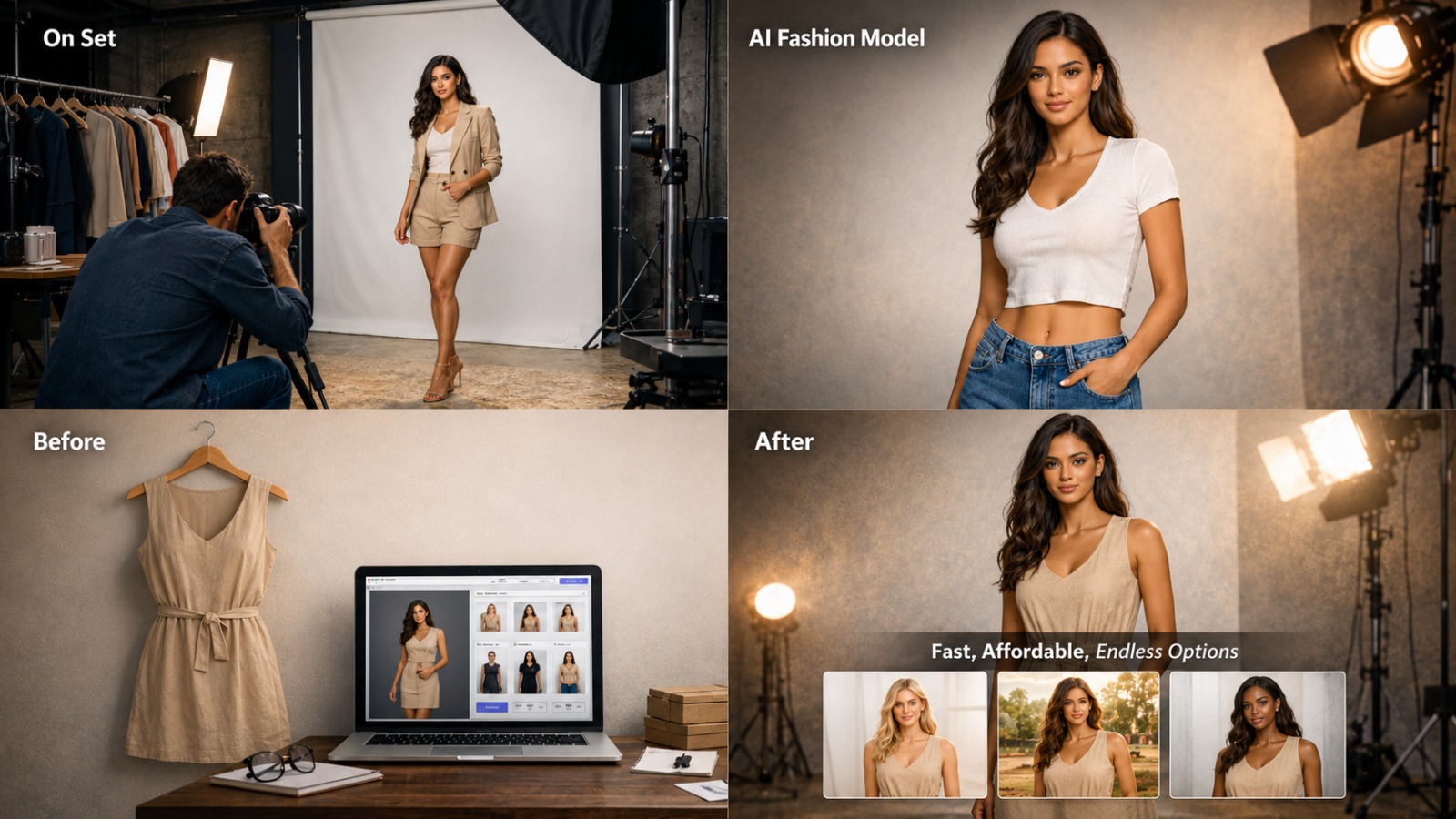
The New Reality of Fashion Content
If you run a fashion brand today, your biggest bottleneck is no longer manufacturing.
It’s content.
Every SKU needs:
- Model shots
- Social creatives
- Ad variations
- Marketplace images
And the faster you move, the more content you need.
Traditional photoshoots were never built for this speed.
They are linear, expensive, and operationally heavy.
AI changes that completely.
Today, leading brands are creating entire lookbooks, campaign creatives, and catalog images without organizing a single physical shoot.
---
What Exactly Are AI Fashion Models?
AI fashion models are not just “fake humans.”
That’s a simplistic view.
They are part of a new content generation stack where:
- The garment is real
- The model is generated
- The environment is simulated
- The output is production-ready
A Typical Workflow
- Upload product image (hanger, flat lay, or ghost mannequin)
- Select model attributes (gender, size, ethnicity, vibe)
- Choose environment (studio, lifestyle, runway, street)
- Generate multiple outputs instantly
What used to require coordination across 5 vendors now happens inside one interface.
---
Why This Shift Is Happening Now
This is not just about AI getting better.
It’s about pressure from three sides.
---
1. Content Explosion
Instagram, marketplaces, ads, WhatsApp catalogs, quick commerce.
Each channel demands fresh visuals.
A brand launching 50 SKUs a month may need 300–500 images minimum.
Traditional systems cannot keep up.
---
2. Performance Marketing Demands Variation
Ad platforms reward creative diversity.
Winning brands are testing:
- 10–20 creatives per product
- Multiple audiences
- Multiple hooks
AI makes this economically viable.
---
3. Speed Is Now a Competitive Advantage
The brand that launches first often wins.
Waiting 10 days for a shoot is no longer acceptable.
---
Traditional Photoshoot vs AI Workflow
Traditional
- Planning: 3–5 days
- Shoot: 1–2 days
- Editing: 3–7 days
- Revisions: Additional delays
Total: 7–15 days
AI Workflow
- Upload product
- Generate images
- Select outputs
Total: 15–30 minutes
---
The Economics: Why This Is a No-Brainer
Let’s break it down.
Traditional Shoot Costs
- Studio: $250 – $1,200
- Models: $120 – $600
- Photographer: $180 – $900
- Styling + logistics
- Retouching
Total: $600 – $6,000+
AI Cost Structure
- Marginal cost per image is extremely low
- No logistics
- No reshoots
Result
Cost per output drops by up to 90%
But more importantly:
Output increases 10x–20x
---
The Real Unlock: Infinite Creative Variations
This is where AI becomes unfair.
With one product, you can generate:
- Multiple models
- Multiple poses
- Multiple lighting styles
- Multiple backgrounds
From one input.
This changes how brands think about content.
It moves from:
“Let’s do one perfect shoot”
to:
“Let’s generate and test at scale”
---
Where AI Is Already Dominating
1. E-commerce Catalogs
Clean, consistent, scalable.
Perfect for marketplaces like Amazon, Myntra, and Nykaa Fashion.
---
2. Performance Ads
AI enables rapid A/B testing.
You can test:
- Different models
- Different moods
- Different backgrounds
Without additional cost.
---
3. Social Media
Daily content without daily shoots.
This is massive for D2C brands.
---
4. Catalog Expansion
Instead of shooting 20 SKUs, brands can now scale to 200.
---
The Hidden Advantage Nobody Talks About: Approval Speed
Most delays in fashion are not production delays.
They are approval delays.
- Stakeholder feedback
- Creative revisions
- Reshoot dependencies
AI removes this friction.
**You don’t revise. You regenerate.**
This alone can reduce approval cycles by 70–80%.
---
Is AI Output Actually Good Enough?
This is the right question.
The answer is nuanced.
Where AI Works Extremely Well
- E-commerce imagery
- Paid ads
- Social media
- Fast fashion
Where Hybrid Still Wins
- Luxury campaigns
- High-fashion editorials
- Brand films
The smartest brands are not choosing one.
They are using:
AI for scale + shoots for storytelling
---
What Separates Good AI from Bad AI
This is critical.
Most tools fail here.
1. Fabric Realism
Bad AI = plastic look
Good AI = texture, folds, weight
2. Fit Accuracy
Garments should not distort or misrepresent sizing.
3. Lighting Consistency
Shadows, highlights, and skin tones must look natural.
4. Brand Alignment
Not just “a good image”
But “your brand’s image”
5. Detail Handling
Advanced systems combine:
- AI generation
- Controlled refinement layers
This is what creates premium outputs.
---
What This Means for Fashion Teams
This is not just a tool change.
It’s a workflow shift.
Old Roles
- Shoot coordinator
- Retouching teams
- Vendor managers
New Roles
- Prompt direction
- Creative selection
- Output curation
Teams become smaller.
But more strategic.
---
The Future: What Happens Next
Over the next 2–3 years:
- Photoshoots will become optional, not default
- Content will be generated on demand
- Personalization will become standard
Imagine:
**Same product Different model for different audience Automatically**
That’s where this is going.
---
Where Glamore.ai Fits In
Glamore.ai is built specifically for fashion.
Not generic AI.
It focuses on:
- Fabric-aware rendering
- Fashion-specific model generation
- Scalable content workflows
- Optional high-detail outputs for premium use
It is designed to fit into real brand workflows, not just create demo images.
---
FAQs
What are AI fashion models?
AI-generated models used to showcase clothing without physical photoshoots.
Can AI replace fashion photoshoots?
For most commercial use cases like e-commerce and ads, yes.
Is AI fashion photography realistic?
Modern systems can produce highly realistic outputs, especially when trained on fashion datasets.
How much can brands save using AI?
Typically between 70% to 90% compared to traditional shoots.
Do brands still need photoshoots?
Yes, but mainly for high-end storytelling and brand campaigns.
---
Final Thought
Fashion content is no longer constrained by production.
It is constrained by imagination and speed.
The brands that understand this shift early will:
- Launch faster
- Test more
- Scale effortlessly
Everyone else will keep waiting for their next shoot.