Every Fashion Brand Can Now Afford a Personal Stylist for Every Customer
AI personal stylists are making one-to-one fashion guidance scalable. Learn how fashion brands can use AI to recommend outfits, understand customer preferences, improve conversion, reduce returns and create more personalized shopping experiences.
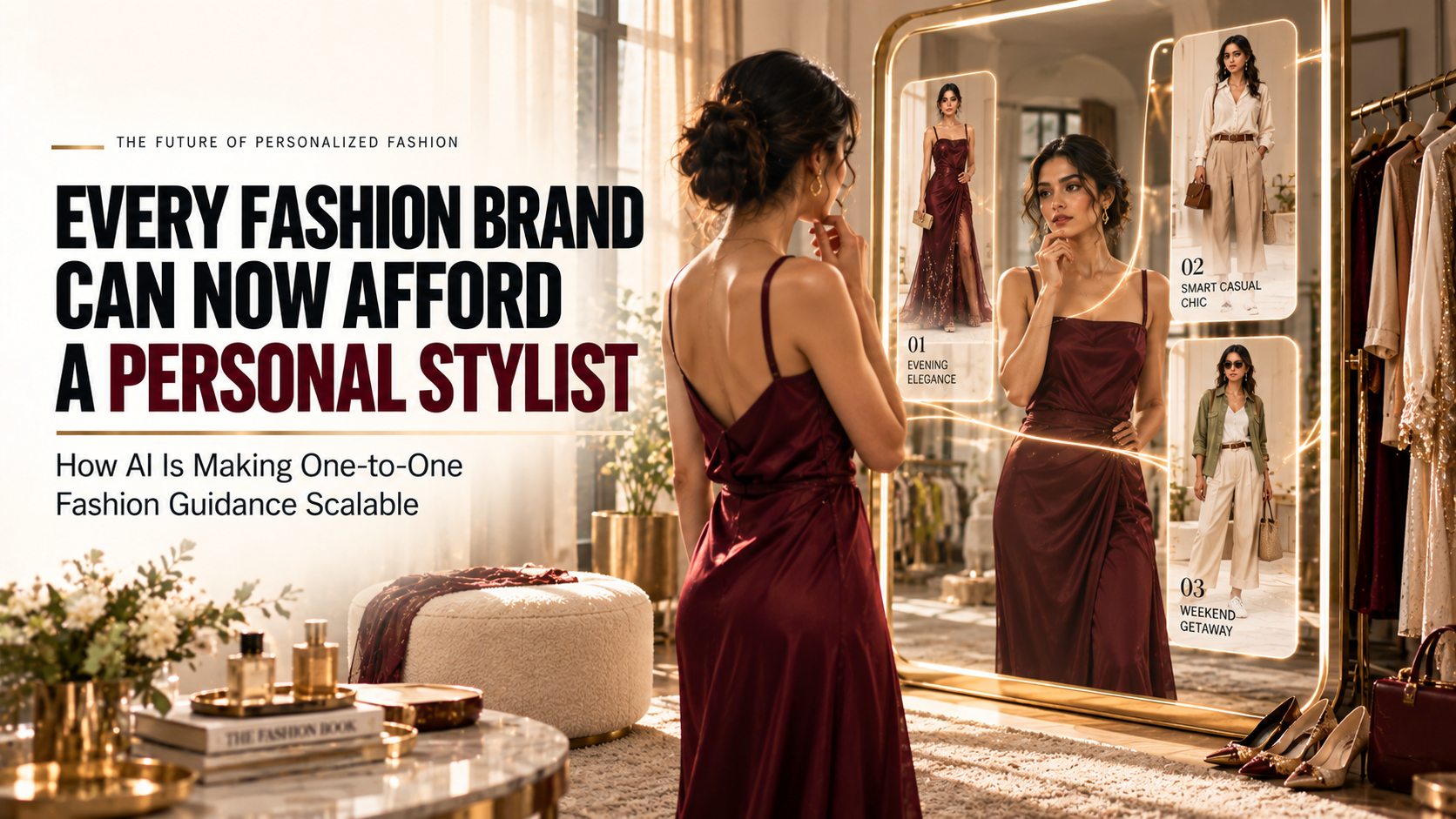
Introduction: Personal Styling Is No Longer Only for Luxury Retail
For decades, great fashion retail had one major advantage over ecommerce.
A good salesperson.
Walk into a strong fashion store and an experienced stylist can quickly understand:
- Your size
- Your body shape
- Your budget
- The occasion
- Your style
- What you already own
- What you are trying to achieve
Then they make recommendations.
Not just products.
Answers.
That kind of personal service has historically been expensive and difficult to scale.
A fashion brand could give one premium customer a stylist.
It could not give one million customers a stylist.
AI changes that.
The next generation of fashion ecommerce is moving beyond simple recommendation engines toward AI personal shoppers and AI stylists that can understand context, preferences, fit and intent through natural conversation.
The result could be one of the biggest shifts in digital fashion retail:
> Every customer gets a stylist.
Not once.
Not only in a store.
But every time they shop.
---
What Is an AI Fashion Stylist?
An AI fashion stylist is a digital shopping assistant that recommends products, outfits and styling combinations based on a shopper’s individual needs.
Unlike a traditional recommendation engine, which often relies mainly on browsing or purchase history, an AI stylist can potentially understand richer context such as:
- Style preferences
- Size
- Body profile
- Budget
- Occasion
- Climate
- Previous purchases
- Existing wardrobe
- Preferred colours
- Fit preferences
Modern AI personal-shopping systems are increasingly moving in this direction, combining natural-language conversations, behavioral data, visual analysis and wardrobe context to create more personalized recommendations.
---
Why This Is Different From “You May Also Like”
Traditional ecommerce recommendations usually work like this:
> Customers who viewed this also viewed that.
Useful.
But limited.
An AI stylist can respond to a much more human request.
> “I need something for an evening wedding in Jaipur. I want to look elegant but not overdressed. My budget is $300.”
That is not a product-search query.
It is a styling brief.
The AI can interpret:
- Occasion
- Formality
- Budget
- Climate
- Personal taste
Then create a recommendation.
That is much closer to real retail assistance.
---
Fashion Shopping Is an Advisory Problem
Customers often do not know exactly what they want.
They know what they need to achieve.
For example:
> “I want something that makes me look taller.”
> “I need a capsule wardrobe for a business trip.”
> “What should I wear with these trousers?”
> “I want an outfit that works from office to dinner.”
A search bar is not good at answering these questions.
A stylist is.
That is why fashion may become one of the strongest use cases for conversational AI in ecommerce.
---
What Can an AI Personal Stylist Actually Do?
1. Understand Occasion
A customer says:
> “I need something for a beach wedding.”
The stylist understands that this is different from:
- Officewear
- Cocktail dressing
- Formal eveningwear
- Resortwear
It can then recommend suitable silhouettes, fabrics and styling.
2. Understand Style
Instead of only showing popular products, the AI can learn whether the customer prefers:
- Minimal
- Classic
- Streetwear
- Bohemian
- Luxury
- Feminine
- Sporty
- Modest
Over time, recommendations can become more relevant.
3. Understand Fit
If connected to sizing and fit intelligence, the AI can recommend not just what to buy, but which size may suit the shopper.
Emerging fashion systems are already combining conversational styling with size profiles and body data to create more individualized recommendations.
4. Build Complete Outfits
Instead of suggesting one product, the stylist can assemble:
- Top
- Bottom
- Shoes
- Bag
- Accessories
This improves the shopping experience and can also increase basket size.
5. Remember What the Customer Already Bought
Imagine asking:
> “What can I wear with the black trousers I bought last month?”
If the AI knows the shopper’s purchase history, it can create relevant combinations.
That moves ecommerce from transaction memory to wardrobe memory.
6. Respect Budget
A real stylist understands budget.
An AI stylist can too.
For example:
> “Give me a complete weekend look under $200.”
That is much more useful than simply sorting products from low to high price.
---
The Virtual Closet Changes Everything
The real power comes when the AI understands what the customer already owns.
A virtual closet can contain information about:
- Previous purchases
- Uploaded wardrobe items
- Colours
- Categories
- Sizes
- Frequently worn combinations
Emerging AI styling platforms are already exploring wardrobe-management systems that combine shopping history, closet data and personal preferences.
Now the AI can answer questions such as:
> “Do I already own something similar?”
> “What can I wear with this?”
> “What am I missing from my wardrobe?”
> “Build me three outfits without buying more than two new items.”
That creates a much deeper relationship than standard ecommerce.
---
From Selling Products to Managing Wardrobes
This is a strategic shift.
Traditional fashion ecommerce asks:
> How do we sell this product?
AI styling can ask:
> Where does this product fit into this customer’s life?
That creates an opportunity for fashion brands to move from being stores to becoming ongoing style partners.
---
Why This Matters for Smaller Fashion Brands
Historically, personal styling was easier for:
- Luxury boutiques
- Department stores
- Premium retailers
Because they had trained staff.
A startup could rarely afford to give individualized attention to every shopper.
AI changes the economics.
A young brand can potentially provide personalized styling support without hiring hundreds of stylists.
That means AI can help smaller brands compete on service, not only price.
---
AI Stylists Can Work 24/7
Traditional customer service has operating hours.
An AI stylist can work whenever the customer shops.
At midnight.
During lunch.
On weekends.
This matters because ecommerce does not happen on a retail schedule.
Customers expect immediate answers.
---
Website + WhatsApp + Social
The AI stylist does not need to live only on the website.
It can potentially work across:
- Website chat
- Mobile app
- Instagram messaging
- Customer-service channels
A shopper could ask on WhatsApp:
> “I bought your linen trousers. What top should I wear with them?”
The AI responds with three options.
That turns messaging into personalized commerce.
---
The AI Stylist Can Become a Salesperson
This is an important commercial point.
A strong stylist does not merely answer questions.
They help customers make decisions.
For example:
Customer:
> “I’m not sure which dress works for a work dinner.”
AI stylist:
> “Based on your preference for neutral colours, I would choose the navy midi. It has a structured silhouette that works for work, but the neckline makes it appropriate for dinner. Pair it with the gold earrings you purchased previously.”
That answer creates confidence.
Confidence drives conversion.
---
Better Recommendations Can Also Reduce Returns
A bad recommendation can create a sale.
Then create a return.
A good recommendation should optimize for:
> Likelihood to keep, not only likelihood to click.
If the AI understands:
- Fit preference
- Size history
- Return history
- Style
- Occasion
It can make more appropriate recommendations.
That makes personalization economically useful beyond conversion.
---
AI Stylists Can Improve Cross-Selling
Traditional cross-selling often looks like:
> “Complete the look.”
But the recommendations may be generic.
An AI stylist can make cross-selling contextual.
For example:
> “You already own white sneakers, so rather than recommending another pair, add this tan bag to complete the look.”
That feels more helpful and less like upselling.
---
Human Stylists Still Matter
AI does not eliminate professional stylists.
It changes how their expertise can scale.
Human stylists remain particularly valuable for:
- Luxury customers
- Complex occasions
- High-ticket purchases
- Cultural nuance
- VIP relationships
- Creative styling
AI can handle routine styling.
Human experts can focus where their judgment creates the most value.
The best model may become:
> AI stylist first. Human stylist when needed.
---
AI + Human Styling Could Be Better Than Either Alone
Imagine a brand has ten human stylists.
Without AI, each stylist handles a limited number of customers.
With AI:
- AI handles simple questions
- AI prepares customer context
- AI suggests initial looks
- Human stylists refine high-value cases
One stylist can serve many more customers.
That makes personal service more scalable without removing the human relationship.
---
Why Product Data Becomes Critical
An AI stylist cannot recommend products it does not understand.
Fashion brands need richer product information such as:
- Fit
- Silhouette
- Fabric
- Occasion
- Colour
- Styling compatibility
- Season
- Size availability
- Price
- Inventory
If product data is weak, the stylist becomes generic.
AI styling is therefore not just an AI project.
It is also a product intelligence project.
---
Images and Videos Make AI Styling More Powerful
Fashion is visual.
A good AI stylist should not only describe outfits.
It should show them.
Imagine asking:
> “Show me how these trousers would look styled for dinner.”
The AI could produce a relevant fashion visual.
Or:
> “Show me three ways to style this jacket.”
Three visual looks appear.
This is where generative images and video become part of the styling experience rather than simply marketing assets.
---
Personalization Can Become Creative
Today most personalization decides:
> Which product should we show?
Tomorrow it may decide:
> How should we show the product?
One shopper sees the garment:
- Styled minimally
- On a model similar to them
- In a work context
Another sees the same garment:
- Styled more boldly
- In eveningwear
- On a different model
Same SKU.
Different visual story.
---
The AI Stylist Can Learn
Every interaction creates signals.
The customer says:
> “Too formal.”
The AI learns.
> “I don’t wear sleeveless.”
It learns.
> “I prefer natural fabrics.”
It learns.
Over time, the experience improves.
The relationship becomes cumulative rather than starting from zero on every visit.
---
What Data Should Brands Use Carefully?
Personal styling can involve sensitive customer information.
Fashion brands need clear rules around:
- Consent
- Personal data
- Images
- Body measurements
- Purchase history
- Data retention
More personalization does not automatically mean better personalization.
The customer must trust the brand.
---
A Simple Roadmap for a Fashion Startup
A startup does not need to build the perfect AI stylist immediately.
Stage 1: Product Q&A
Let customers ask natural questions about products.
Stage 2: Occasion Recommendations
Allow shoppers to say:
> “I need something for a wedding.”
Stage 3: Outfit Building
Recommend complete looks.
Stage 4: Customer Memory
Use prior purchases and preferences with appropriate consent.
Stage 5: Fit Intelligence
Add sizing and body-profile guidance.
Stage 6: Visual Styling
Generate images or video demonstrating recommended looks.
Start with usefulness.
Then add intelligence.
---
How to Measure an AI Stylist
Do not measure only chatbot engagement.
Measure commercial outcomes.
Track:
- Conversion rate
- Add-to-cart
- Average basket size
- Repeat purchase
- Return rate
- Customer-service reduction
- Customer satisfaction
The goal is not to make people talk to AI.
The goal is to make shopping better.
---
The AI Stylist Could Become the Customer-Facing Part of the Fashion AI Brain
This connects to a much larger idea.
Internally, a fashion brand may have an AI Brain that understands:
- Products
- Customers
- Inventory
- Content
- Brand guidelines
Externally, the AI stylist becomes one interface into that intelligence.
The customer asks:
> “What should I wear?”
The answer uses product data, inventory, purchase history and styling knowledge together.
That is much more powerful than an isolated chatbot.
---
Where Glamore.ai Fits
At Glamore.ai, we believe AI fashion experiences will become increasingly visual, conversational and personalized.
Our work in AI-generated fashion imagery, video, virtual try-on and enterprise Fashion AI systems points toward a future where a fashion brand can understand a customer and then instantly create the content and recommendations needed to serve them.
An AI stylist represents an important part of that future.
Not because fashion should remove human stylists.
But because personal service should no longer be limited to the few customers who can access one.
The opportunity is simple:
> Give every shopper someone to ask.
---
Frequently Asked Questions
What is an AI fashion stylist?
An AI fashion stylist is a digital assistant that recommends clothing, outfits and accessories based on customer preferences, size, budget, occasion, purchase history and other relevant context.
How is an AI stylist different from product recommendations?
Traditional recommendations often rely mainly on browsing and purchase patterns. An AI stylist can understand natural-language requests, styling intent, occasion and personal preferences to recommend complete looks.
Can small fashion brands use AI personal stylists?
Yes. Smaller brands can begin with conversational product discovery and outfit recommendations before adding advanced features such as fit intelligence or virtual closets.
Can AI stylists recommend the right size?
If connected to reliable fit and sizing data, AI stylists can provide size recommendations. Accuracy depends on the quality of body, garment and historical sizing information.
Can an AI stylist reduce fashion returns?
Potentially. Better fit, occasion and style recommendations may help customers choose products they are more likely to keep.
Will AI stylists replace human stylists?
Not completely. Human stylists remain valuable for complex, creative and high-value interactions. AI can make routine personal styling scalable while human experts handle situations requiring deeper judgment.
Can AI stylists work on WhatsApp?
Yes. Conversational styling can potentially operate across websites, apps, messaging platforms and customer-service channels, provided the commerce and product systems are properly connected.
What information does an AI stylist need?
Useful inputs include product attributes, inventory, sizing, customer preferences, purchase history, fit information and, where customers explicitly choose to provide it, wardrobe or body-profile data.
---
Final Thought: Personal Service Is Becoming Software
The best physical fashion stores have always understood something ecommerce forgot.
People do not only want access to products.
Sometimes they want advice.
They want someone to say:
> “This suits you.”
> “Try this instead.”
> “Wear these together.”
> “This is the right size.”
AI is making that kind of assistance scalable.
The future of fashion ecommerce may therefore not be a larger product grid.
It may be a much smaller number of highly relevant recommendations delivered through a conversation.
A personal stylist used to be a luxury.
Soon, it may simply be part of the store.