The Return Problem Is Becoming a Profit Problem: How AI Can Help Fashion Brands Reduce Returns
Fashion returns are becoming a serious profitability challenge for ecommerce brands. Discover how AI-powered sizing, fit intelligence, product content, virtual try-on, review analysis and return intelligence can help fashion businesses reduce avoidable returns and improve net conversion.
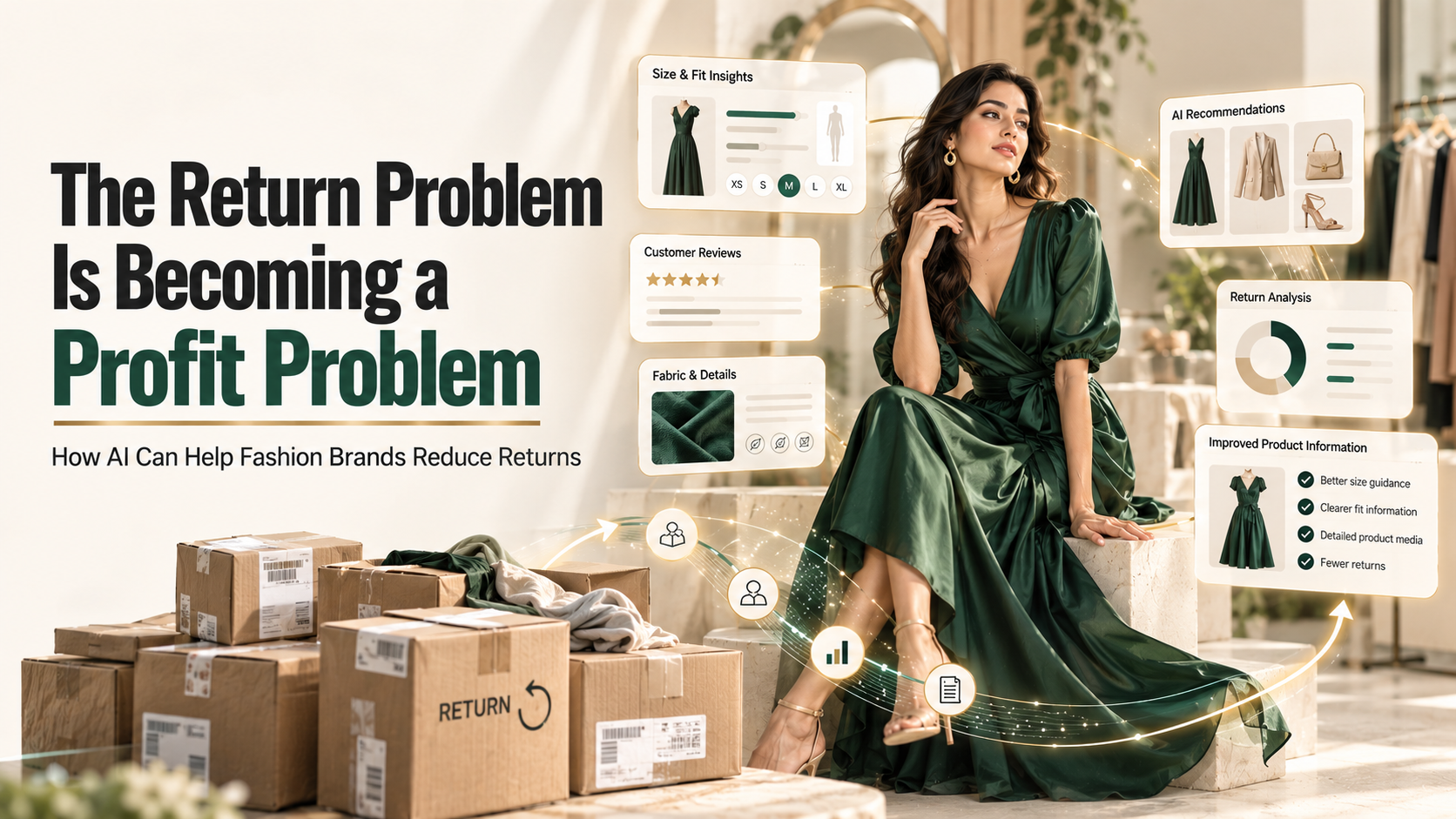
Introduction: Fashion Returns Are No Longer Just an Operations Issue
Fashion ecommerce has a strange problem.
A sale does not always mean revenue.
A customer can discover a product, click an ad, visit the website, place the order, receive the parcel, and then send the product back.
The brand pays for almost every step:
- Customer acquisition
- Payment processing
- Picking and packing
- Shipping
- Reverse logistics
- Inspection
- Restocking
- Sometimes markdowns
And after all that, the sale disappears.
That is why returns are increasingly becoming a profitability problem rather than simply a customer-service problem.
Fashion is especially exposed because shoppers cannot physically try, touch or inspect a garment before buying.
Sizing can be inconsistent. Fit can be subjective. Colours can look different on screen. Fabric expectations can be wrong. Photography can make products appear different from reality.
The good news is that artificial intelligence can now help fashion brands reduce many avoidable returns before they happen.
The objective is not to make returns impossible.
It is to help customers make better purchase decisions the first time.
---
Why Are Fashion Ecommerce Returns So High?
Fashion has several characteristics that make returns unusually common.
1. Fit Is Difficult to Judge Online
A customer may know their usual size, but that does not mean every garment fits the same way.
A Medium in one brand may fit like a Small in another.
Even within the same brand, different cuts and fabrics can behave differently.
2. Product Expectations Do Not Match Reality
Customers may receive a garment and think:
> “The colour looked different online.”
> “The fabric is thinner than I expected.”
> “I thought this would be more fitted.”
> “That dress looked longer on the model.”
These are not always product-quality failures.
Often they are information failures.
3. Static Images Cannot Show Everything
A photograph can show a garment.
It cannot always show:
- Movement
- Weight
- Stretch
- Drape
- Transparency
- Texture
Video and richer product visualization can reduce that gap.
4. Customers Often Buy Multiple Sizes
Some shoppers deliberately order two or three sizes of the same product and return the ones that do not fit.
This gives the customer confidence but creates significant logistics costs for the retailer.
5. Return Reasons Are Often Poorly Analysed
Many brands collect return reasons but do not use them deeply.
- Too small
- Too large
- Did not like
- Not as expected
Hidden inside that data are product, fit, photography and merchandising problems that may repeat across hundreds of orders.
AI can help surface those patterns.
---
The Most Important Shift: Prevent the Return Before the Purchase
Historically, returns management focused on what happened after the customer wanted to send something back.
The better approach is to ask:
> Why did the customer need to return it in the first place?
That changes the role of AI.
Instead of simply optimizing reverse logistics, AI can help brands improve the purchase decision before checkout.
---
1. AI Size Recommendations Can Reduce Fit Uncertainty
Basic size charts ask customers to compare their measurements against a table.
AI-assisted fit systems can go further.
They may use signals such as:
- Height
- Weight
- Body measurements
- Previous purchases
- Previous returns
- Brand sizing history
- Product construction
- Fabric stretch
- Customer feedback
The system can then recommend:
> “Based on your previous purchases, we recommend Medium.”
For the customer, this reduces uncertainty.
For the brand, better first-time sizing can reduce avoidable exchanges and returns.
---
2. Fit Intelligence Should Be Product-Specific
One of the biggest mistakes fashion brands make is treating size as the only fit information.
Customers also need to understand how the garment is intended to sit.
For example:
- Relaxed fit
- Slim fit
- Oversized
- High rise
- Cropped
- Structured
- Stretch fit
AI can help standardize and enrich this information across large catalogues.
Instead of:
> “Women’s black trousers.”
The product information becomes:
> “High-waisted tailored trousers with a straight leg and structured non-stretch fabric. Designed for a close fit at the waist and relaxed fit through the leg.”
That description helps both humans and AI shopping assistants understand the product better.
---
3. Better AI-Generated Product Content Can Reduce Expectation Gaps
The best way to reduce “not as expected” returns is to improve expectations.
A product page should answer the questions the customer would ask inside a physical store.
- What does the fabric look like closely?
- How does it move?
- How does it fit on different bodies?
- What does it look like from the back?
- How long is it?
- What would I wear it with?
AI makes it possible to create more of this content economically.
A single SKU can be represented through:
- Multiple model images
- Different body types
- Close-up details
- Styling variations
- Product movement videos
- Occasion-based imagery
The goal is not to make the product look better than reality.
The goal is to help the customer understand it more accurately.
---
4. Video Can Prevent Returns That Photography Cannot
Fashion products exist in motion.
A dress that appears beautiful in a photograph may behave completely differently when walking.
AI-assisted video can help show:
- Drape
- Length
- Movement
- Fabric behaviour
- Styling
For high-return categories, adding useful video may be more valuable than adding another static photograph.
---
5. Virtual Try-On Can Improve Confidence, But It Must Be Used Carefully
Virtual try-on has improved significantly.
It can help customers visualize how a garment may look on a body or on their own image.
But brands should be careful about claiming perfect fit accuracy.
Visualization and sizing are different problems.
A virtual try-on may help answer:
> “Does this style suit me?”
A fit engine may help answer:
> “Which size should I buy?”
The strongest experience combines both rather than pretending one solves everything.
---
6. AI Can Identify High-Return Products Early
This may be one of the most commercially valuable applications.
Imagine a new collection launches.
After the first 200 orders, AI notices:
- One dress has twice the average return rate
- Most customers cite “too small”
- Size Large has particularly high returns
- Reviews repeatedly mention a tight waist
The brand does not need to wait until thousands of units have been sold.
It can act immediately.
Possible actions include:
- Update size guidance
- Change the fit description
- Adjust product imagery
- Recommend sizing up
- Review future production
- Investigate the pattern with the supplier
AI turns return data into early warning signals.
---
7. Return Data Can Improve Product Development
Returns should not be treated only as a logistics event.
They are customer feedback.
If one silhouette consistently gets returned because of fit, the design team should know.
If a certain fabric repeatedly disappoints customers, buying should know.
If one supplier produces inconsistent sizing, sourcing should know.
If one style looks very different in photography versus reality, creative teams should know.
A connected AI system can send those insights back into the organisation.
That creates a powerful loop:
> Sell → Learn → Improve → Sell Better
---
8. AI Can Separate Product Problems From Customer Problems
Not every return means the product is bad.
Suppose a jacket has high returns.
AI analysis may discover:
- The return rate is normal for existing customers
- It is unusually high among first-time customers acquired through one ad campaign
- That campaign shows the jacket styled as oversized
- The actual product is more fitted
The issue may be marketing, not manufacturing.
Without connected analysis, the team might incorrectly blame the product.
AI can help diagnose the commercial story behind the return.
---
9. Reviews Are an Underused Returns Prevention Tool
Customer reviews contain enormous amounts of fit intelligence.
Comments like:
> “Runs small.”
> “Size up.”
> “Perfect for taller women.”
> “Fabric is heavier than expected.”
> “Looks more beige than white.”
AI can analyse thousands of reviews and summarize useful insights directly on the product page.
For example:
What customers say about fit:
- 72% say true to size
- 18% recommend sizing up
- Most customers describe the fabric as medium weight
That information can significantly improve purchase confidence.
---
10. Personalization Can Prevent the Wrong Customer Buying the Wrong Product
Sometimes the problem is not the product.
It is who bought it.
An AI-driven store can learn what tends to work for individual customers.
If someone repeatedly returns fitted dresses but keeps relaxed silhouettes, the system can adjust future recommendations.
This is where personalization becomes economically interesting.
It does not only increase conversion.
It can potentially improve quality of conversion.
A sale that stays sold is more valuable than a sale that comes back.
---
The Metric Fashion Brands Should Start Watching: Net Conversion
Brands often obsess over conversion rate.
Imagine two stores.
Store A
- Conversion rate: 4.5%
- Return rate: 30%
Store B
- Conversion rate: 4%
- Return rate: 15%
Which business is performing better?
Probably Store B.
That is why fashion brands should increasingly think about:
> Net conversion after returns.
AI optimization should not simply ask:
> “How do we make more people buy?”
It should also ask:
> “How do we help the right people buy the right product?”
---
How a Small Fashion Brand Can Start
You do not need a giant technology project.
Step 1: Measure Returns Properly
Track return rate by:
- SKU
- Size
- Colour
- Category
- Customer type
- Acquisition channel
Step 2: Improve Return Reasons
Avoid vague categories where possible.
Capture:
- Too small
- Too large
- Colour mismatch
- Fabric expectation
- Quality issue
- Style did not suit
- Product different from imagery
Step 3: Identify the Worst 10 SKUs
Do not try to fix the whole catalogue.
Find the products creating the biggest return costs.
Step 4: Improve Their Content
Add:
- Better fit descriptions
- Model measurements
- Multiple body types
- Detail imagery
- Video
- Size recommendations
Step 5: Use AI to Analyse Patterns
Ask:
- Why is this SKU being returned?
- Which sizes have the highest problem rate?
- Which acquisition channels produce the most returns?
- Which product attributes correlate with high returns?
Step 6: Measure Again
The question is simple:
> Did the return rate improve?
If yes, scale the method.
---
The Economics Matter More Than the Technology
Suppose a brand generates $5 million in online sales and has a 20% return rate.
That is $1 million of merchandise coming back through the system.
Even a modest reduction can produce meaningful savings across:
- Logistics
- Customer service
- Packaging
- Processing
- Markdown exposure
- Lost inventory availability
This is why returns prevention deserves attention at the CEO and founder level.
It is not merely a fulfilment metric.
It is a margin lever.
---
Better Returns Intelligence Can Also Improve Sustainability
Every return creates movement.
Pickup.
Transport.
Inspection.
Repackaging.
Sometimes disposal.
Reducing avoidable returns can therefore improve both economics and resource efficiency.
The most sustainable return is often the one that never needed to happen.
---
AI Should Not Be Used to Make Returns Difficult
There is an important distinction.
AI can help brands identify abuse and repeat fraud.
But reducing returns should not mean making legitimate customer returns painful.
A bad return experience can destroy trust.
The better strategy is:
> Prevent avoidable returns before purchase.
Then make unavoidable returns simple and transparent.
---
Where the Fashion AI Brain Fits
The real opportunity appears when return intelligence connects with the rest of the business.
Imagine one AI system capable of connecting:
- Product information
- Ecommerce sales
- Customer reviews
- Return reasons
- Marketing creative
- Supplier information
- Inventory
- Customer behaviour
A merchant could ask:
> “Why does this dress have a high return rate?”
And receive an answer such as:
> “Returns are concentrated in first-time customers purchasing Size M. The most common reason is tight fit at the waist. Reviews show the same pattern. The current product page describes the fit as regular. Consider changing the description to fitted and recommending customers between sizes to size up.”
That is far more useful than another returns dashboard.
It is intelligence.
---
Where Glamore.ai Fits
At Glamore.ai, we see AI fashion content and AI commerce intelligence increasingly coming together.
- Better imagery
- Better video
- More representative models
- Clearer product visualization
- AI-assisted fit
- Product intelligence
- Return analytics
These are not separate ideas.
They all solve one fundamental ecommerce problem:
> Helping customers understand what they are buying before they buy it.
Our broader vision is to help fashion companies build AI-powered systems that improve not only how products are presented, but how the entire fashion business learns from customer behaviour.
Because the objective should not simply be more orders.
It should be more successful orders.
---
Frequently Asked Questions
Why are fashion ecommerce return rates so high?
Fashion purchases depend heavily on sizing, fit, colour, fabric and appearance. Online customers cannot physically try products before purchase, which creates uncertainty and expectation gaps.
How can AI reduce fashion returns?
AI can improve size recommendations, analyze return reasons, identify high-return SKUs, summarize review insights, improve product descriptions and support richer product visualization.
Can AI predict which fashion products will have high returns?
AI can identify patterns in early sales, sizing, customer feedback and return data that may indicate unusually high return risk. Predictions are not perfect, but they can provide useful early warnings.
Does virtual try-on reduce returns?
Virtual try-on can improve style confidence and visualization, but it should not automatically be treated as a substitute for accurate sizing and fit guidance.
What content helps reduce fashion returns?
Useful content includes model measurements, fit descriptions, fabric information, multiple body representations, detailed imagery, product video, customer reviews and accurate size guidance.
Can small fashion brands use AI to reduce returns?
Yes. A small brand can begin by analyzing SKU-level return reasons, improving content for high-return products and using AI to identify patterns before investing in sophisticated systems.
What is net conversion in fashion ecommerce?
Net conversion considers whether purchases remain sold after returns rather than measuring checkout conversion alone. It can provide a more commercially meaningful view of ecommerce performance.
---
Final Thought: The Best Return Strategy Starts Before Checkout
Fashion brands will never eliminate returns.
Nor should they try.
Customers need the confidence that they can return something when it genuinely does not work.
The opportunity is to eliminate the returns that should never have happened.
- The wrong size
- The misunderstood fit
- The unexpected fabric
- The misleading photograph
- The product purchased by the wrong customer
AI gives fashion companies new ways to identify and reduce those problems.
The brands that use it well will not merely generate more conversions.
They will generate better conversions.
And ultimately, the most profitable fashion order is not the one that converts fastest.
It is the one the customer loves enough to keep.