The AI Workforce: Why Every Fashion Brand Will Soon Have Digital Employees
Discover how AI employees and digital workforces are transforming fashion brands by automating repetitive tasks, accelerating creativity, and helping teams achieve better business outcomes through enterprise AI.
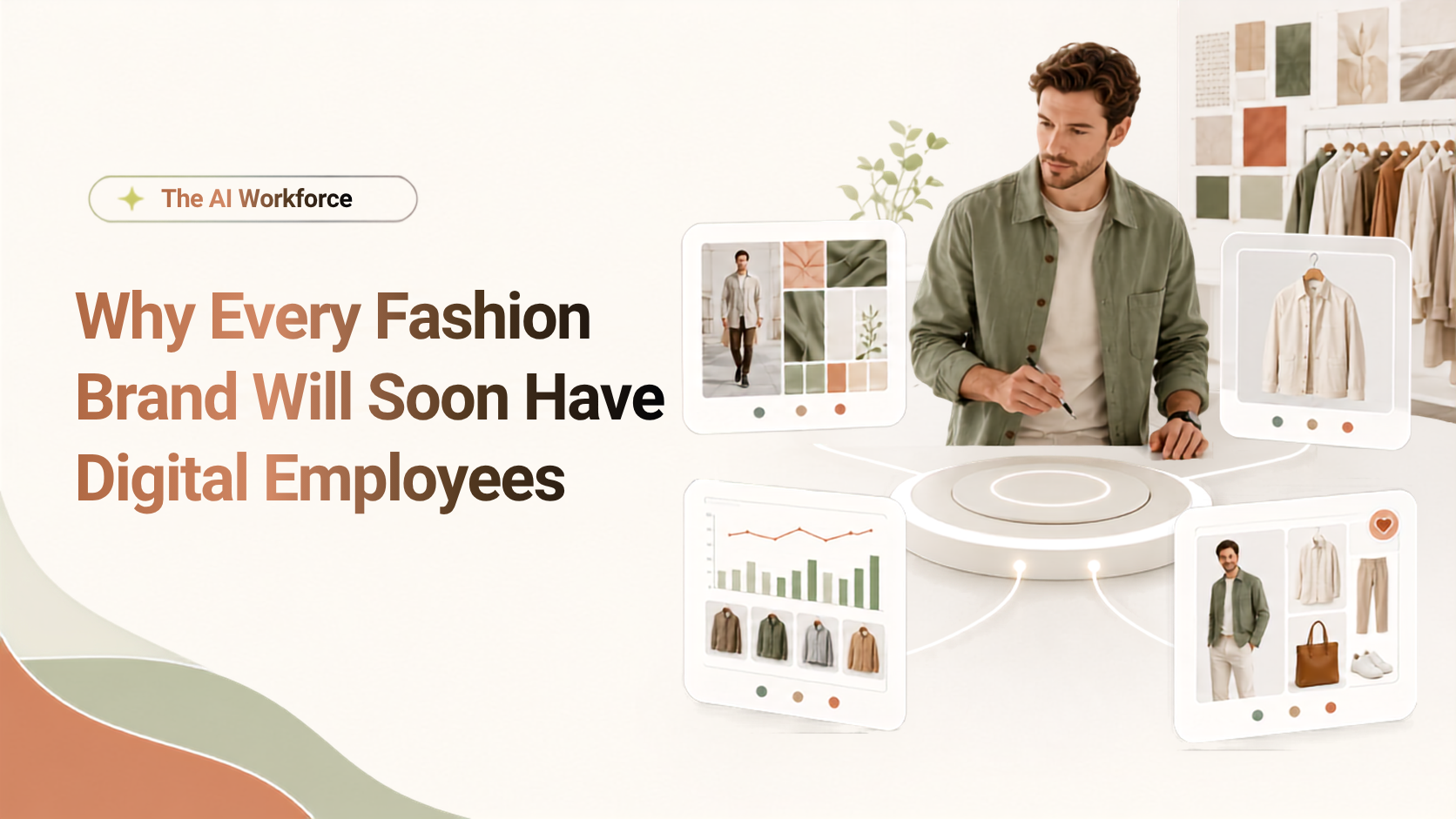
The AI Workforce: Why Every Fashion Brand Will Soon Have Digital Employees
Introduction: The Next Hire at Your Fashion Company Won't Be Human
For decades, fashion businesses have grown by hiring more people.
Need more marketing?
Hire a marketing manager.
Need more product photography?
Hire photographers.
Need more customer support?
Expand the support team.
Need better merchandising?
Recruit experienced merchandisers.
Growth has traditionally meant increasing headcount.
Artificial intelligence is beginning to challenge that assumption.
Not because it replaces people.
But because it introduces a completely new category of worker.
The AI Employee.
Unlike software, an AI employee does not simply provide tools.
It performs work.
It collaborates with people.
It learns from organisational knowledge.
And it operates continuously.
The future fashion company may not just have designers, marketers, merchandisers, and buyers.
It may also have digital employees working alongside them.
What Is an AI Employee?
An AI employee is an intelligent software agent trained to perform a specific business function.
Unlike a chatbot, an AI employee understands:
- Company knowledge
- Workflows
- Objectives
- Approvals
- Brand guidelines
- Historical decisions
It doesn't simply answer questions.
It completes work.
Think of it as giving every department an intelligent digital team member.
From AI Tools to AI Colleagues
The first generation of AI focused on individual tasks.
- Writing emails
- Generating images
- Creating presentations
The second generation connects those abilities into specialised AI agents.
Instead of asking:
"Can AI generate an image?"
Businesses will ask:
"Can our AI Campaign Manager launch the entire collection?"
The conversation changes completely.
Every Department Will Have AI Employees
Rather than replacing teams, AI employees expand them.
Imagine walking into a fashion company in 2030.
Alongside every human team sits a specialised AI workforce.
AI Creative Director
Responsibilities
- Develop campaign concepts
- Generate mood boards
- Recommend visual styles
- Maintain brand consistency
- Create creative briefs
It works alongside designers, not instead of them.
AI Fashion Photographer
Instead of scheduling studios, this employee produces:
- Catalogue photography
- Campaign imagery
- Lifestyle visuals
- Product close-ups
- Regional adaptations
Available 24/7.
AI Video Producer
Creates:
- Product videos
- Social media reels
- Collection launch films
- Talking AI presenters
- Localised video campaigns
One product.
Hundreds of video assets.
AI Merchandiser
Analyses:
- Sell-through rates
- Regional demand
- Inventory levels
- Assortment gaps
- Markdown opportunities
Recommends actions before problems appear.
AI Buyer
Monitors:
- Supplier performance
- Market trends
- Demand forecasts
- Pricing changes
Helping buying teams make better sourcing decisions.
AI Customer Stylist
Works directly with customers.
It understands:
- Purchase history
- Preferred colours
- Favourite silhouettes
- Sizing
- Seasonal interests
Instead of generic recommendations...
Every conversation becomes personalised.
AI Customer Service Executive
Available every hour of every day.
It understands:
- Returns
- Orders
- Shipping
- Products
- Policies
- Loyalty
- Escalations
Most importantly...
It learns.
AI Marketing Strategist
More than creating content.
It also:
- Understands campaign performance
- Optimises campaigns
- Suggests new audiences
- Creates advertisements
- Generates landing pages
- Prepares influencer campaigns
- Reports business insights
AI Brand Historian
This role doesn't exist today.
It soon will.
It remembers:
- Every campaign
- Every collection
- Every photoshoot
- Every supplier
- Every launch
- Every lesson learned
It prevents organisations from losing valuable institutional knowledge.
Why This Changes Everything
Today's organisations operate through departments.
Tomorrow's organisations may operate through intelligence networks.
Humans focus on:
- Creativity
- Relationships
- Leadership
- Judgement
- Innovation
AI employees focus on:
- Research
- Production
- Analysis
- Coordination
- Execution
- Documentation
Together they create a far more capable organisation.
This Isn't About Replacing Jobs
This is perhaps the biggest misconception surrounding AI.
Fashion has always adopted technology.
Digital pattern making did not eliminate designers.
CAD software did not replace creativity.
Ecommerce did not eliminate retail.
Similarly, AI employees will not replace professionals.
They remove repetitive work that prevents professionals from doing higher-value thinking.
The future belongs to teams where humans and AI work together.
The Fashion Workforce of the Future
Imagine a creative team preparing a new collection.
Instead of spending three weeks organising production...
They brief their AI workforce.
Within hours they receive:
- Campaign concepts
- Product photography
- Videos
- Regional adaptations
- Translations
- Landing pages
- Email campaigns
- Retail POS material
- Merchandising suggestions
- Forecast reports
The human team:
- Reviews
- Refines
- Approves
- Launches
This dramatically changes how fast fashion companies can move.
Why This Matters Today
Many executives believe this future is years away.
In reality, parts of it already exist.
AI can already:
- Generate fashion photography
- Produce realistic product videos
- Create presentations
- Summarise meetings
- Answer customer questions
- Write campaign copy
- Translate content
- Analyse business reports
The next step is connecting these capabilities into specialised enterprise AI employees.
Where Glamore.ai Fits
At Glamore.ai, we believe the future of fashion is not simply powered by AI tools.
It is powered by intelligent AI workforces.
Our vision extends beyond generating images or videos.
We see a future where every fashion company has access to specialised AI employees that understand:
- Products
- Customers
- Workflows
- Brand identity
- Business goals
Working together through a central Fashion AI Brain, these digital employees help organisations move faster, make better decisions, and deliver exceptional customer experiences.
Frequently Asked Questions
What is an AI employee?
An AI employee is an intelligent software agent that performs specific business tasks using organisational knowledge, workflows, and enterprise data.
How can AI employees help fashion brands?
They can support creative production, marketing, merchandising, customer service, ecommerce, buying, analytics, and enterprise knowledge management.
Will AI employees replace fashion professionals?
No.
They automate repetitive tasks while enabling professionals to focus on creativity, leadership, and strategic decision-making.
Can AI employees work together?
Yes.
Multiple specialised AI agents can collaborate through a shared enterprise knowledge platform, often referred to as an AI Brain.
Are AI employees already being used?
Many businesses already use early forms of AI employees through intelligent agents for customer support, marketing, content generation, and internal operations.
# Final Thoughts
Every industrial revolution introduced new tools.
Artificial intelligence introduces something different.
A new kind of workforce.
The fashion brands that embrace AI employees early will not simply become more efficient.
They will become fundamentally more intelligent.
And in the coming decade, intelligence may become the industry's most valuable competitive advantage.