Every Fashion Product Will Soon Need a Video: How AI Is Making Video-First Commerce Affordable
Fashion ecommerce is becoming video-first. Discover how AI is making catalog-level fashion video affordable, helping brands turn every SKU into a richer content ecosystem across ecommerce, social media, marketplaces and performance marketing.
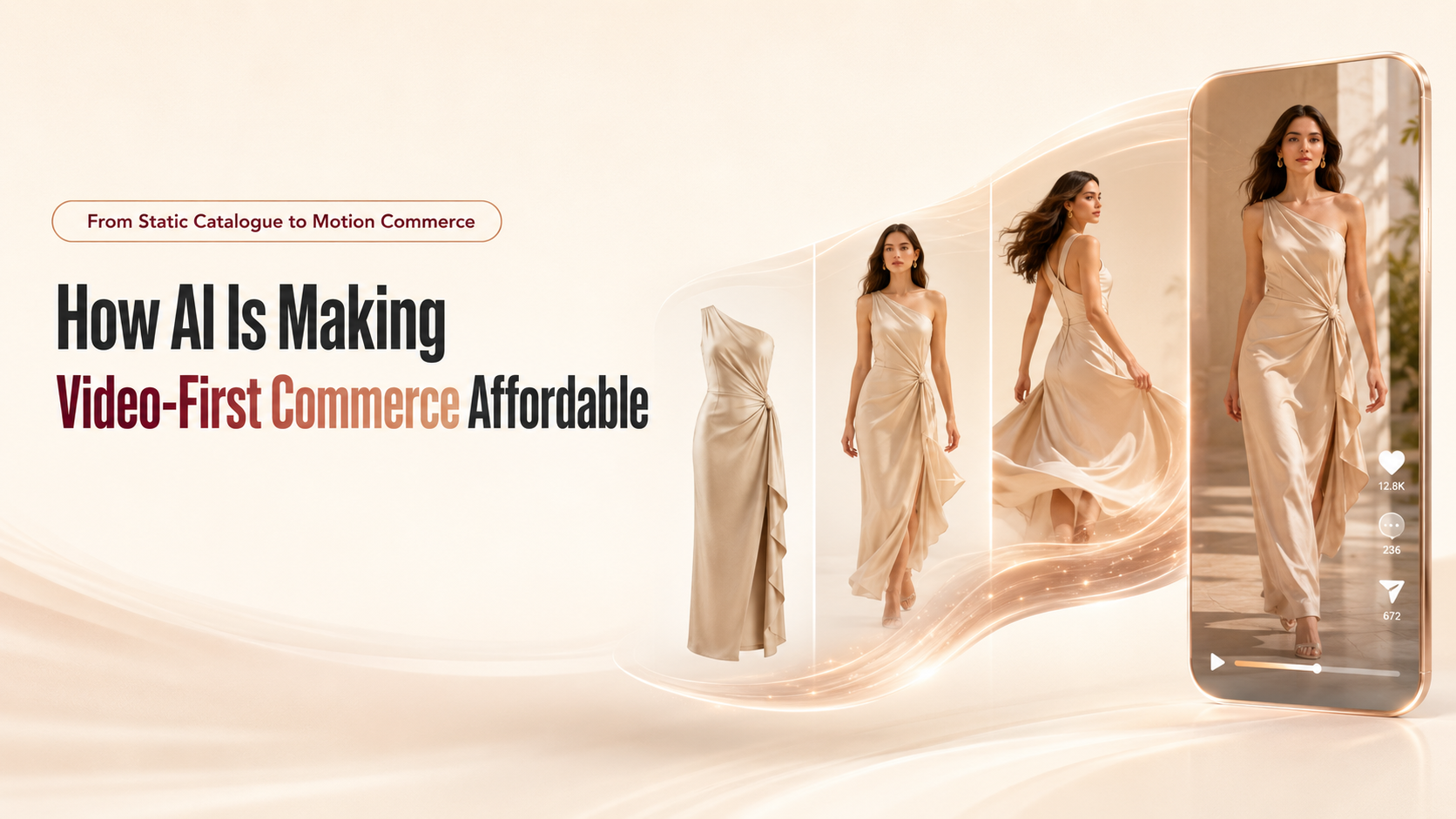
# Every Fashion Product Will Soon Need a Video: How AI Is Making Video-First Commerce Affordable
Introduction: Fashion Ecommerce Is Becoming Video-First
For years, fashion ecommerce was built around static images.
* Front view. * Back view. * Side view. * Detail shot.
That was enough.
Not anymore.
Shopping is becoming more visual, more social and more video-led. Consumers increasingly discover fashion through Reels, creator content, short-form video and conversational shopping journeys rather than only through search bars and category pages.
Meta’s 2026 India ecommerce research describes this shift as a move from “search-and-transact” toward a scroll-led discovery ecosystem powered by AI, short-form video and messaging. It also notes that major fashion marketplaces such as Ajio and Myntra are actively scaling catalog product video as part of their always-on commerce strategy.
For fashion brands, especially startups and D2C labels, this creates a simple question:
If customers increasingly expect motion, why is most of your catalogue still static?
The answer used to be cost.
Video required models, cameras, studios, editors and production schedules.
AI is changing that economics completely.
Why Video Matters More in Fashion Than in Most Categories
Fashion is about movement.
A garment can look completely different when it moves.
* A dress drapes. * A jacket holds structure. * A fabric catches light. * A skirt flows. * A sleeve falls differently depending on the pose.
Static photography can show the product.
Video can show how the product feels.
That difference matters because online shoppers cannot touch, try or physically inspect the garment before buying.
Video helps reduce that gap.
It gives customers additional context around:
* Fit * Movement * Texture * Styling * Scale * Occasion * Overall feel
This is why video is becoming increasingly valuable across fashion discovery, ecommerce and performance marketing.
From Five Photos Per SKU to a Full Content Package
The old ecommerce content model looked something like this:
One product → Five photographs → Product page → Maybe one campaign post
The new model is much richer.
One product can potentially create:
* Catalogue images * Model images * Product movement video * Reel * Paid social ad * Styling video * Marketplace video * Story format * Creator-style video * Regional-language version * Campaign cut-downs
One SKU becomes an entire content library.
This is the real opportunity created by AI video.
It is not simply about making videos faster.
It is about dramatically increasing the amount of usable content a fashion brand can create from the same product.
Why Fashion Brands Historically Avoided Video at Scale
Video has always been attractive.
The problem was production economics.
To create a professional product video, a brand traditionally needed some combination of:
* Model * Studio * Photographer or videographer * Lighting * Styling * Editing * Music * Voiceover * Multiple aspect ratios
That works for a hero campaign.
It becomes expensive when multiplied across 100, 500 or 5,000 SKUs.
As a result, fashion companies typically reserved video for:
* Campaign launches * Bestseller products * Influencer collaborations * Brand films
Most of the catalogue remained static.
AI changes the cost curve.
How AI Video Changes Fashion Content Production
AI video systems can now generate or animate content from existing product images and creative assets.
A simplified workflow can look like this:
Product image → AI model or campaign image → Image-to-video generation → Movement → Multiple edits → Social, ecommerce and advertising formats
Instead of recreating everything physically, brands can start with assets they already have.
This makes video viable for far more products.
What Types of Fashion Videos Can AI Help Create?
1. Product Movement Videos
Show how a garment behaves when the model walks, turns or moves.
Useful for:
* Product pages * Marketplaces * Social advertising * Reels
2. Fashion Reels
Turn campaign imagery into short-form motion content.
One campaign can produce multiple Reels with different:
* Hooks * Cuts * Music styles * Text overlays * Formats
3. Styling Videos
One product can be shown across several looks.
For example:
**One blazer. Three ways to wear it.**
This transforms product content into useful fashion advice.
4. AI Model Videos
A product photographed on a hanger or model can be transformed into a more dynamic model-led fashion visual.
This gives smaller brands access to content styles that previously required larger production budgets.
5. Talking Fashion Videos
AI presenters or talking models can explain:
* New collections * Product features * Styling suggestions * Fabric benefits * Offers
This is particularly useful for social, WhatsApp and performance campaigns.
6. Localized Videos
A strong video can be adapted into different:
* Languages * Markets * Offers * Product combinations
Instead of recreating the entire campaign, brands can generate variations.
Video Is No Longer Just a Branding Asset
This is an important shift.
Historically, fashion video was largely treated as brand content.
Beautiful films.
Runway footage.
Campaign storytelling.
Today, video is becoming a commerce asset.
It can sit directly in the buying journey.
A customer discovers a garment in a Reel.
They see the product moving.
They click.
They view a second video on the product page.
They receive a styling video through retargeting.
Then perhaps a WhatsApp message closes the journey.
Video is no longer separate from ecommerce.
It is becoming part of ecommerce.
The Rise of Catalog Product Video
One of the most important 2026 signals is that catalog-level video is beginning to move from experiment to operating model.
At Meta’s 2026 ecommerce summit in India, Ajio’s CMO said catalog product video had become part of its always-on media strategy and reported approximately 20% higher efficiency from that approach. Myntra also said it was looking to test generative catalog product video templates to increase video-first discovery across its catalogue.
Source: https://about.fb.com/news/2026/05/from-scroll-to-chat-to-cart-trends-reshaping-how-india-shops/
That matters because Ajio and Myntra operate at enormous catalogue scale.
If video becomes economically viable across large marketplaces, smaller brands should assume customer expectations will eventually follow.
AI Makes Video More Accessible to Startups
This is where the shift becomes particularly interesting.
A large fashion company can always build a video production team.
A startup cannot.
But a startup can now use AI to create a much broader content footprint without building a studio.
Imagine a young brand launching 30 new SKUs.
Instead of choosing five products for video, it could potentially create motion content for every one.
That means smaller brands can compete on creative volume, not just budget.
One Product, Multiple Channels
AI video also makes repurposing much easier.
A single source creative could become:
* Instagram * Vertical Reel * Meta Ads * Short performance creative * Website * Product movement clip * Marketplace * Clean product video * YouTube Shorts * Story-led version * WhatsApp * Short product explainer
The content remains connected.
The format changes with the channel.
Why This Matters for Performance Marketing
Performance advertising increasingly depends on creative variation.
One ad rarely works forever.
Audiences fatigue.
Platforms need new creative inputs.
Brands need to test:
* Different hooks * Different models * Different backgrounds * Different opening frames * Different product benefits
Video historically made that expensive.
Generative AI makes experimentation more affordable.
The brand can create more versions and allow actual performance data to determine what works.
AI Video Does Not Mean Zero Human Involvement
There is an important caution here.
AI video can still make mistakes.
Fashion is particularly sensitive to errors because the product must remain truthful.
Brands need to check:
* Garment details * Logo accuracy * Pattern consistency * Buttons * Zips * Hands * Fabric behaviour * Fit * Product colour
The objective is not to generate as much content as possible regardless of quality.
It is to generate more high-quality content with a controlled review workflow.
Human creative direction remains essential.
A Simple AI Video Strategy for a Fashion Startup
A startup does not need to transform its entire catalogue immediately.
Start small.
Step 1: Pick 10 Important SKUs
Choose:
* Best sellers * New launches * High-margin products * Products that benefit from showing movement
Step 2: Create Three Video Types Per Product
For example:
- Product movement
- Social Reel
- Styling or campaign video
Now 10 SKUs produce 30 video assets.
Step 3: Test Them
Measure:
* Engagement * Click-through * Add-to-cart * Conversion * Watch time
Step 4: Learn What Works
Perhaps customers respond better to:
* Close-up details * Walking shots * Creator-style videos * Model-led videos * Styling explainers
Step 5: Scale the Winning Format
Now use AI to expand the successful creative pattern across more products.
This is much smarter than generating hundreds of videos without a strategy.
The Future Product Page Will Look Different
A future fashion product page may contain:
* Product images * Movement video * Different models * Styling suggestions * Customer reviews * AI try-on * AI stylist * Short product explanation
The product page becomes less like a catalogue entry and more like an interactive selling experience.
Video will be central to that evolution.
AI Video + Personalization Will Be Even More Powerful
The bigger opportunity comes when video connects with personalization.
Instead of showing everyone the same product video, brands could eventually show:
* Different styling * Different models * Different languages * Different contexts * Different offers
The product remains the same.
The creative adapts to the customer.
That is where generative fashion content becomes much more than production automation.
It becomes part of the customer experience.
Where Glamore.ai Fits
Glamore.ai began by helping fashion brands create high-quality AI-generated fashion imagery.
We are now extending that capability into video.
The goal is simple:
Help fashion brands turn every product into a richer content asset.
From model imagery and campaign visuals to product videos, Reels and motion-led creative, Glamore.ai is designed to help brands create more content without rebuilding the traditional production structure behind every asset.
For a growing fashion brand, this means the ability to move from:
One product → A few photographs
to
One product → An entire visual content ecosystem.
Frequently Asked Questions
Why is video becoming important for fashion ecommerce?
Video helps shoppers understand movement, fit, styling and fabric behaviour in ways static photography cannot. It is also increasingly central to social discovery and performance advertising.
Can AI create product videos for fashion brands?
Yes. AI video tools can generate or animate fashion content from images, campaign assets and other references. Human review is still important to maintain product accuracy.
Is AI fashion video affordable for small brands?
Increasingly yes. AI reduces the need to physically shoot every video variation, making catalog-level video much more accessible to D2C brands and startups.
What fashion videos should a startup create first?
Start with movement videos, short social Reels and simple styling videos for best-selling or important products. Test performance before scaling.
Can AI replace fashion video shoots completely?
Not necessarily. Traditional shoots remain valuable for high-end brand storytelling and major campaigns. AI is particularly powerful for catalog content, variations, testing and always-on digital production.
How can AI video help fashion advertising?
AI makes it easier to create multiple video variations, test different creative concepts and refresh advertisements without repeatedly organizing new shoots.
What is catalog product video?
Catalog product video refers to short video content created at product or SKU level rather than only for major campaigns. It can be used across ecommerce pages, marketplaces, social platforms and advertising.
Final Thought: Every SKU Is Becoming a Media Asset
The ecommerce catalogue used to be a database of products.
Increasingly, it is becoming a library of media.
Images.
Videos.
Stories.
Styling ideas.
Personalized creative.
AI is making that transformation economically possible.
The question for fashion brands is no longer:
“Should we create video?”
It is becoming:
“How much useful video can we create around every product?”
The brands that answer that question early will not simply have better content.
They will have more opportunities to be discovered, understood and chosen.
And that is why the future fashion catalogue is unlikely to remain static.
Every product is becoming a video product.