The AI Brand Test: Is Your Fashion Business Actually Ready for AI?
Take this 10-point AI readiness test for fashion brands and discover whether your business has the product data, workflows, governance, systems and team readiness needed to use AI effectively.
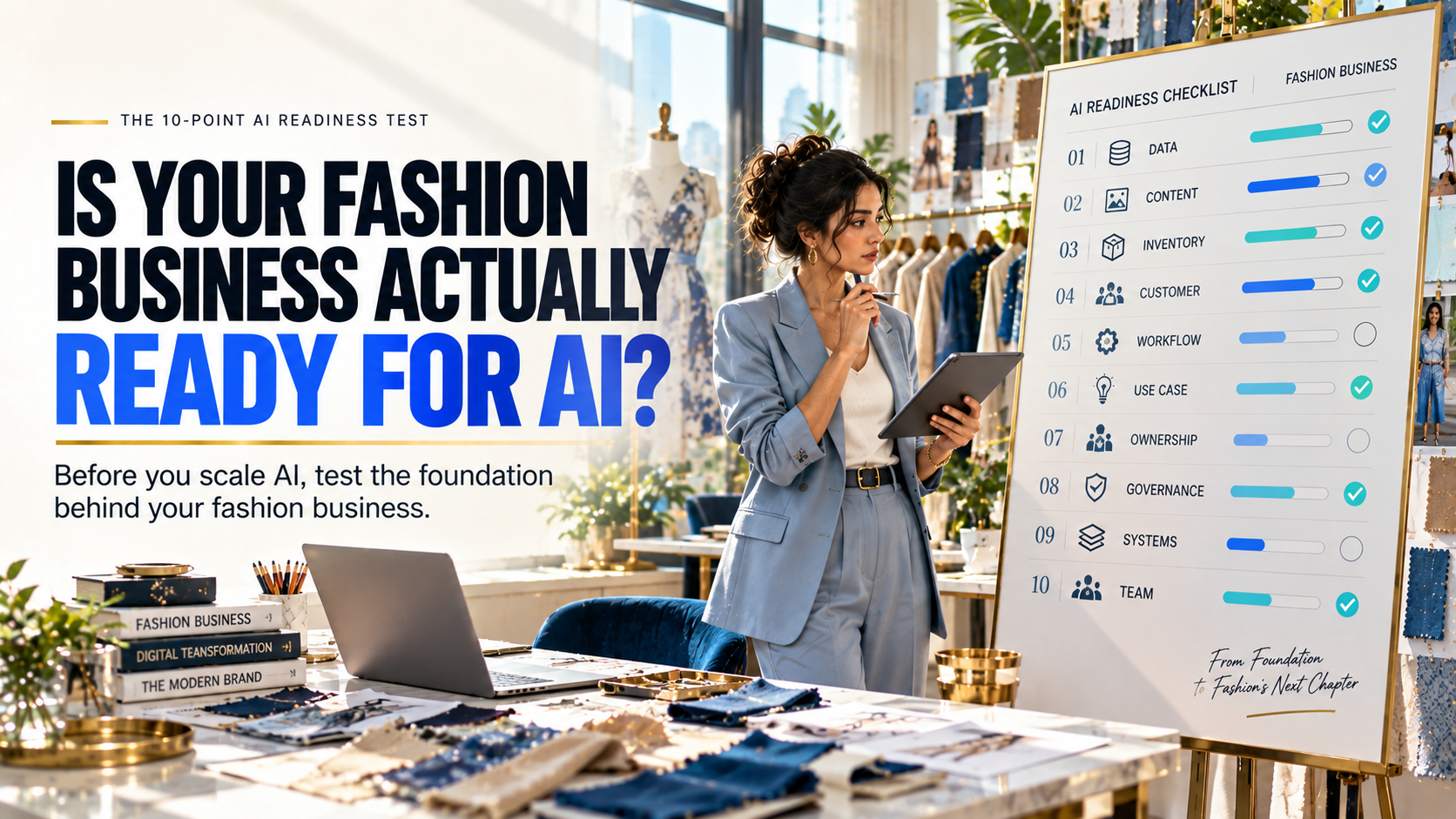
Introduction: Most Fashion Brands Do Not Need More AI Tools
Fashion brands are being told to adopt AI everywhere.
AI for content.
AI for customer service.
AI for forecasting.
AI for product discovery.
AI for design.
AI for merchandising.
AI for ecommerce.
The natural reaction is:
> “Which AI tools should we buy?”
That is often the wrong first question.
Because AI works exceptionally well when the business underneath it is ready.
And poorly when it is not.
A company with incomplete product information, messy inventory, scattered files, unclear processes and no ownership of AI can buy the best AI tools in the world and still get disappointing results.
This is becoming one of the biggest lessons of the current AI cycle.
McKinsey says data readiness is now one of the main constraints as companies try to move AI from pilots into scaled business use. TCS similarly argues that fashion retailers need disciplined product data, shared architecture, clear governance and workforce readiness before AI can scale reliably.
So before asking:
> “Which AI should we implement?”
Fashion brands should ask:
> “Are we actually ready for AI?”
This simple 10-point test can help answer that.
---
What Does AI Readiness Mean for a Fashion Brand?
AI readiness is the ability of a company to use artificial intelligence reliably and productively across real business workflows.
It does not mean:
- Having a ChatGPT subscription
- Generating a few campaign images
- Testing one chatbot
- Buying an AI tool
A fashion company is AI-ready when its data, workflows, people and governance are strong enough for AI to create repeatable business value.
That usually requires five foundations:
- Good information
- Connected systems
- Clear workflows
- Human ownership
- Specific business outcomes
The technology comes after that.
---
Why This Matters Now
AI in fashion is moving quickly from experimentation to infrastructure.
McKinsey describes AI as shifting from a competitive advantage toward a business necessity, while Vogue Business says the fashion industry is moving beyond experimentation into AI infrastructure.
But adoption is uneven.
TCS’s 2026 Global Retail Outlook found that 85% of retailers surveyed had not yet begun implementing or planning multi-agent AI systems, and only 24% were using AI for autonomous decision-making.
That gap creates opportunity.
A startup does not need to become technologically sophisticated overnight.
It simply needs to become more prepared than its competitors.
---
The Fashion AI Readiness Test
Give your company one point for every statement you can confidently answer YES to.
Be strict.
If the answer is “sort of”, count it as a no.
---
1. Do You Have a Reliable Product Truth?
Can your team find accurate information for every important SKU?
That includes:
- Product name
- Category
- Colour
- Size
- Fit
- Fabric
- Price
- Inventory
- Product description
- Care information
- Images
- Video
If three departments have three different versions of the same product information, AI will inherit the confusion.
This is one of the most important foundations.
Google’s 2026 retail research found that only 42% of product pages in its Northern European study were structured well enough for AI agents to read effectively.
Score Yourself
YES: Product data is structured, accurate and centrally managed.
NO: Product information lives across spreadsheets, email, WhatsApp and different systems.
---
2. Is Your Content Library Organized?
Fashion businesses create enormous amounts of visual material.
- Campaign photography
- Product images
- Videos
- Reels
- Lookbooks
- Logos
- Brand guidelines
- Influencer content
- Historical campaigns
Can your team easily answer:
> “Show me all approved imagery from our Summer 2025 campaign featuring linen products.”
If the answer requires asking three people and searching ten folders, your AI will struggle too.
AI becomes powerful when it can retrieve the right creative asset instantly.
Score Yourself
YES: Content is labelled, searchable and organized.
NO: Assets are scattered across Drive folders, desktops and agency links.
---
3. Is Your Inventory Information Trustworthy?
Imagine an AI stylist recommends the perfect outfit.
Then the customer clicks.
Out of stock.
AI commerce depends on accurate operational information.
Your systems need reliable:
- Inventory
- Availability
- Pricing
- Sizes
- Store stock
If inventory cannot be trusted, AI recommendations cannot be trusted either.
Score Yourself
YES: Stock and availability are reasonably accurate across channels.
NO: Teams regularly discover inventory errors manually.
---
4. Can You Understand Your Customer?
You do not need a giant CRM.
But you should know something about your customers.
Useful information might include:
- Purchase history
- Repeat purchase
- Categories bought
- Average order value
- Return behaviour
- Location
- Loyalty
- Customer-service issues
AI personalization cannot work properly if every customer is effectively anonymous.
Score Yourself
YES: Customer information can be connected to meaningful business decisions.
NO: Data exists but is rarely used outside basic reporting.
---
5. Are Your Business Processes Documented?
This is one of the most underestimated AI readiness questions.
Imagine hiring a new employee and saying:
> “Manage our product launches.”
Their first question would be:
> “How?”
AI has the same problem.
To automate a workflow, the business needs to understand the workflow first.
Processes worth documenting include:
- Product launch
- Campaign approval
- Content production
- Returns
- Customer escalation
- Inventory replenishment
- Supplier onboarding
AI struggles when the process exists only inside someone’s head.
Score Yourself
YES: Important workflows have clear steps, owners and approvals.
NO: Most processes depend on tribal knowledge.
---
6. Do You Know Which Business Problem AI Should Solve First?
This is crucial.
“Use AI” is not a strategy.
A useful AI objective sounds like:
> “Reduce catalogue production time by 60%.”
Or:
> “Identify high-return SKUs earlier.”
Or:
> “Help customers find the right product faster.”
Or:
> “Give merchandisers a daily replenishment recommendation.”
If the organisation cannot define the problem, it cannot judge whether AI worked.
Score Yourself
YES: You have one or more specific measurable AI use cases.
NO: The goal is simply to “implement AI.”
---
7. Does Someone Own AI Inside the Company?
AI cannot become everyone’s side project.
Someone needs to own:
- Priorities
- Vendors
- Data access
- Governance
- Results
- Training
- Rollout
This does not mean hiring a Chief AI Officer.
For a startup, it might simply be:
- Founder
- Ecommerce head
- CTO
- Operations head
But ownership must be clear.
Score Yourself
YES: One person has clear responsibility for AI adoption.
NO: Everyone experiments independently.
---
8. Do You Have Basic AI Rules?
Fashion companies increasingly need simple guardrails.
For example:
- Can employees upload confidential information into public AI tools?
- Can AI-generated models be used without review?
- Who approves generated product imagery?
- Can AI alter garment details?
- How is customer data handled?
- When should human review be mandatory?
Vogue’s 2026 fashion-tech outlook argues that brands need their own AI guardrails as regulation and practices develop differently across markets.
You do not need a 100-page policy.
You need clarity.
Score Yourself
YES: Employees understand what they may and may not do with AI.
NO: Everyone follows their own rules.
---
9. Can Your Systems Connect?
AI becomes much more valuable when it can work across systems.
For example:
> Ecommerce + Inventory + CRM + DAM + Analytics
If every application is completely isolated, AI becomes another silo.
Your business does not need perfect integration.
But you should know:
- Which systems contain important data
- Whether they have APIs or export capability
- Who owns each source
- Which source is the truth
Score Yourself
YES: Important systems can share data or can reasonably be connected.
NO: Most business information is trapped in isolated systems.
---
10. Is Your Team Willing to Change How It Works?
This may be the most important question.
AI transformation is not purely technical.
It changes workflows.
Employees need to learn:
- What AI does well
- Where it makes mistakes
- How to review output
- When to use it
- When not to use it
McKinsey and TCS both emphasize that workforce readiness and process redesign are critical for scaling AI beyond pilots.
A company can have perfect technology and still fail if nobody changes how they work.
Score Yourself
YES: Teams are willing to learn and redesign workflows.
NO: AI is seen as an IT experiment separate from daily work.
---
Your Fashion AI Readiness Score
Now count your YES answers.
0–3: AI Curious
You are experimenting.
That is fine.
But do not rush into complex AI systems.
Focus first on:
- Product data
- Process documentation
- Content organization
- AI policies
Build the foundation.
4–6: AI Ready
You have enough structure to start implementing meaningful use cases.
Pick one or two problems.
Prove value.
Then expand.
Avoid buying ten tools simultaneously.
7–8: AI Enabled
Your organization is ready to connect multiple AI capabilities.
You can begin exploring:
- AI agents
- Personalized commerce
- AI merchandising
- Content automation
- Internal knowledge assistants
At this stage, integration becomes important.
9–10: AI Native
You have the foundations required to make AI part of how the company operates.
Now the opportunity becomes much larger.
Instead of asking:
> “Where can we use AI?”
You can start asking:
> “How would we redesign this business if AI was available everywhere?”
That is a fundamentally different mindset.
---
What If Your Score Is Low?
Do not panic.
A low score is useful.
It tells you exactly what to fix.
Many companies are still early.
TCS’s 2026 retail study shows that even large retailers remain at relatively basic stages of AI adoption.
The important thing is to build deliberately.
AI rewards businesses that have:
Clear information. Clear processes. Clear ownership.
Not just large technology budgets.
---
A Fashion Startup May Actually Have an Advantage
Large companies have more data.
But they also have:
- Legacy systems
- Complex approvals
- Department silos
- Technical debt
A startup can build correctly from the beginning.
One product database.
One content library.
One customer view.
Documented workflows.
Clear AI rules.
Connected tools.
That can make a young fashion brand more AI-ready than a much larger competitor.
---
Start With Outcomes, Not Technology
This principle deserves repeating.
Do not begin with:
> “We want an AI agent.”
Begin with:
> “Customers struggle to find products.”
Then decide whether the solution is:
- Conversational search
- AI stylist
- Better product data
- Recommendations
Do not begin with:
> “We need generative AI.”
Begin with:
> “Content production takes three weeks.”
Then design the AI workflow around the problem.
Technology should follow the business outcome.
---
Why Product Data Is Becoming Strategic
One of the most interesting changes in 2026 is that product data is no longer only an ecommerce operations issue.
It is becoming a marketing issue.
AI shopping assistants can increasingly discover and recommend products.
But AI systems need structured information.
McKinsey’s State of Fashion 2026 specifically recommends that companies structure product content and data feeds so AI agents can interpret catalogues, while continuing to invest in both GEO and SEO.
That means product information influences:
- Website experience
- AI discovery
- Personalization
- Search
- Customer service
- Agentic commerce
Good data increasingly creates visibility.
---
The Fashion AI Brain Comes Later
A Fashion AI Brain can eventually connect:
- Product
- Customer
- Content
- Operations
- Merchandising
- Retail
- Marketing
But the Brain is only as good as what it knows.
If the underlying data is poor, the AI Brain simply becomes a more sophisticated way of producing the wrong answer.
The sequence should be:
> Organize → Connect → Govern → Automate → Intelligence
Not:
> Buy AI → Hope
---
A 90-Day AI Readiness Plan
If your score is below seven, try this.
Days 1–30: Organize
Choose:
- One product-data source
- One content library
- One inventory truth
Document your five most important workflows.
Days 31–60: Experiment
Pick one measurable AI use case.
For example:
- Product descriptions
- Catalog imagery
- Customer Q&A
- Returns analysis
Measure the impact.
Days 61–90: Connect
Connect the AI workflow with real business data.
Define governance.
Train the team.
Then decide whether to scale.
Three disciplined months can create more value than a year of random AI experimentation.
---
Where Glamore.ai Fits
At Glamore.ai, our view of fashion AI has expanded considerably.
AI imagery and video are powerful starting points because they solve immediate content problems.
But the larger opportunity is helping fashion businesses become AI-ready across:
- Product intelligence
- Creative content
- Customer experience
- Enterprise knowledge
- AI agents
- Fashion AI Brain
The goal should not be to give fashion brands more technology.
It should be to help them become more intelligent businesses.
And that starts with readiness.
---
Frequently Asked Questions
What is AI readiness for fashion brands?
AI readiness is the ability of a fashion company to use artificial intelligence reliably because its product data, systems, workflows, people and governance are sufficiently organized.
Does a small fashion brand need an AI strategy?
Yes, but it can be simple. A startup should identify a small number of high-value business problems and build the data and workflow foundations required to solve them with AI.
What should fashion brands do before adopting AI?
Clean product and inventory data, organize content assets, document important processes, define AI ownership and create basic governance rules.
Do fashion brands need perfect data before using AI?
No. But the data used for a particular AI workflow needs to be sufficiently accurate and reliable for the business decision involved.
What is the biggest barrier to AI adoption?
For many businesses, the barrier is not model capability. It is fragmented data, unclear processes, lack of governance and difficulty changing established workflows.
How can a fashion startup become AI-ready?
Build structured product information, organize creative assets, connect core systems, document workflows and begin with one measurable AI use case.
What is the difference between AI-ready and AI-native?
An AI-ready company can implement AI effectively. An AI-native company designs workflows and business models assuming AI is available throughout the organization.
---
Final Thought: Do Not Automate Chaos
AI is an accelerator.
That means it accelerates good systems.
And bad ones.
If your product information is inconsistent, AI can spread inconsistency faster.
If your processes are unclear, AI can automate confusion.
If your brand direction is generic, AI can generate generic content at enormous scale.
So before asking how much AI your fashion business can adopt, ask something more important:
> How much of our business is ready to be amplified?
That is the real AI readiness test.
Fix the foundation.
Choose the right problem.
Measure the outcome.
Then scale.
Because the most AI-ready fashion company will not necessarily be the one using the most AI.
It will be the one using AI where it creates the most value.