How Fashion Brands Can Get Discovered by ChatGPT, Gemini and AI Shopping Assistants
AI is changing how consumers discover fashion products. Learn how fashion brands can use SEO, GEO, structured product data, rich content, reviews and AI-ready brand information to become more discoverable across ChatGPT, Gemini and AI shopping assistants.
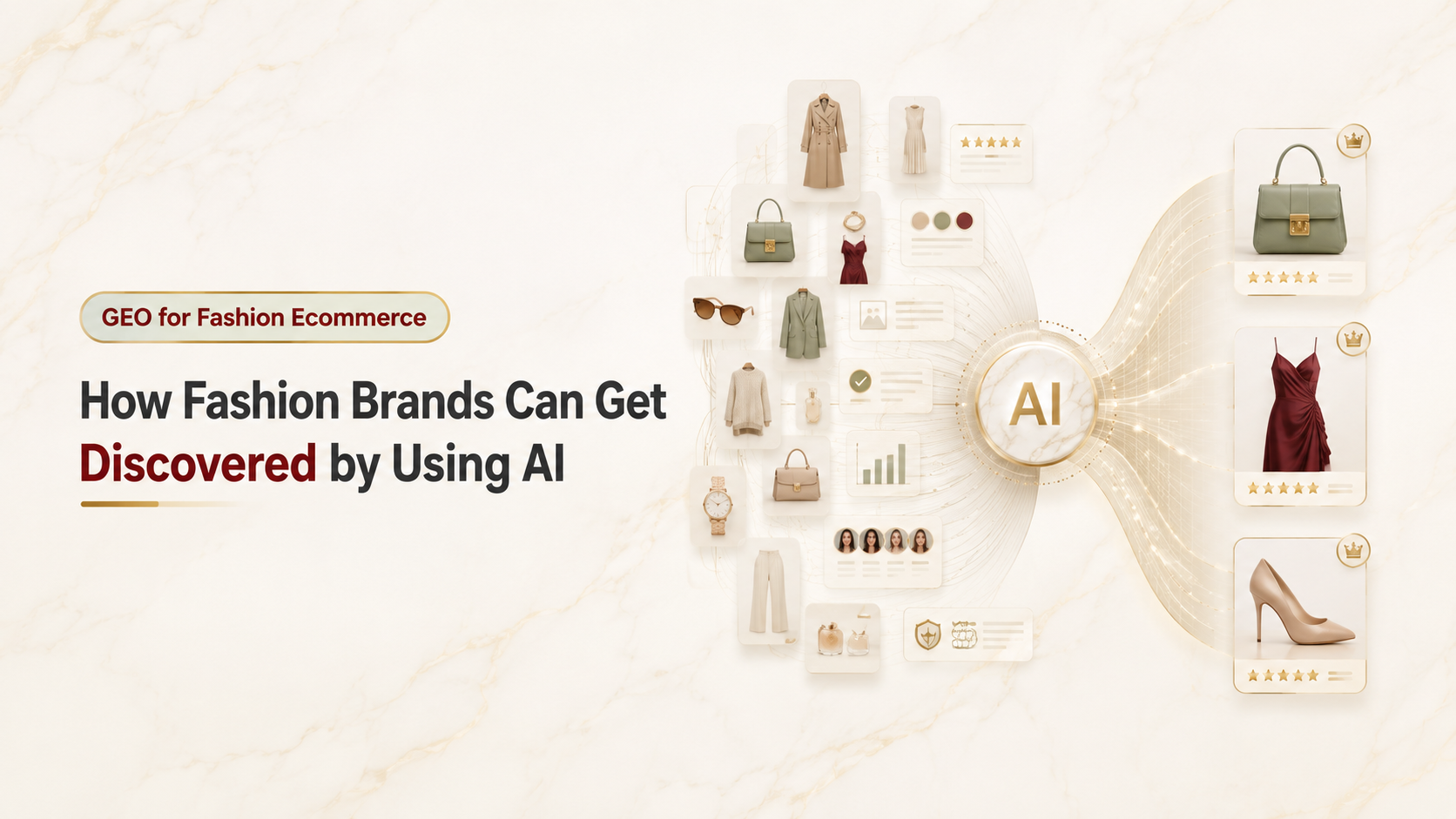
The Next Search Battle in Fashion Is Already Here
For years, fashion ecommerce had a familiar discovery model.
A shopper searched Google.
A brand tried to rank.
The customer clicked through to a website, marketplace listing, social profile or advertisement.
That journey is changing.
Consumers are increasingly asking artificial intelligence systems to help them decide what to buy.
Instead of searching for “black cocktail dress women”, a shopper can now ask:
“Find me an elegant black dress for a summer wedding under $250. I want something minimal, not too formal, and available in size M.”
That is a completely different kind of search.
AI systems such as ChatGPT, Gemini and AI-powered search experiences can interpret intent, compare alternatives, consider constraints, surface products visually and help shoppers refine their decisions conversationally.
For fashion brands, this creates a new challenge.
It is no longer enough to rank on a search results page.
Your brand, products and expertise increasingly need to be understandable to AI systems.
This is where Generative Engine Optimization, often called GEO, becomes important.
But GEO is not a replacement for SEO.
It is the next layer on top of it.
What Is GEO for Fashion Ecommerce?
Generative Engine Optimization is the practice of making your brand, website, products and expertise easier for AI systems to understand, trust, retrieve and potentially recommend when answering user questions.
Traditional SEO asks:
“How do we rank for a keyword?”
GEO asks:
“How do we become a credible answer when an AI is helping someone make a decision?”
For fashion, that could mean appearing when a shopper asks:
- What are good Indian resort wear brands?
- Find sustainable linen shirts under $100.
- Which brands make modern occasion wear for petite women?
- Suggest three outfits for a five-day Dubai holiday.
- What is a good alternative to a traditional lehenga for a destination wedding?
These queries contain context, preferences, price, occasion, fit and intent.
A product page built only around a short title and a few generic keywords may not contain enough information for an AI system to confidently understand when the product is relevant.
Why AI Shopping Discovery Matters Now
AI shopping is moving rapidly from experimentation into mainstream product discovery.
ChatGPT can already surface visual product results, compare products and use merchant product information to improve discovery.
Google is also combining Gemini with its Shopping Graph, allowing consumers to explore products conversationally in Gemini and AI Mode.
This changes the competitive landscape.
In traditional search, brands competed for ten blue links.
In AI discovery, the consumer may receive only a handful of recommendations.
Being understood and trusted becomes extremely valuable.
---
SEO Is Still the Foundation
One mistake brands should avoid is treating GEO as a completely separate discipline.
AI engines still rely heavily on the web ecosystem.
A technically weak website, inconsistent product information, poor authority and thin content will not suddenly become discoverable because someone adds an FAQ section or uses the phrase “AI optimized”.
Fashion brands still need strong SEO fundamentals:
- Crawlable websites
- Fast pages
- Clear site architecture
- Descriptive titles and headings
- Canonical URLs
- Internal linking
- Product structured data
- High-quality editorial content
- Reputable third-party mentions
Think of SEO as making your business discoverable on the web.
GEO makes that information easier for AI systems to interpret and use.
You need both.
---
1. Build Rich Product Information, Not Thin Product Pages
Fashion product pages have historically been surprisingly poor sources of information.
A typical listing might contain:
“Blue midi dress. Polyester. Regular fit.”
That may be enough to display a product.
It is not enough to explain it.
AI-driven discovery rewards context.
A stronger product page should clearly describe:
- Product category
- Colour
- Material
- Fabric characteristics
- Fit
- Silhouette
- Length
- Sleeve style
- Neckline
- Occasion
- Seasonality
- Styling suggestions
- Care information
- Size availability
- Price
- Stock status
- Shipping geography
For example, instead of:
“White linen shirt”
consider information such as:
“Relaxed-fit women’s white linen shirt made from lightweight breathable linen, designed for warm-weather travel, resort wear and casual office styling. Available in XS to XL.”
You are not writing this only for a search engine.
You are describing the product clearly enough that humans and machines can understand when it is relevant.
---
2. Make Product Data Machine-Readable
Good copy is important.
Structured data is equally important.
Fashion brands should maintain accurate machine-readable information for:
- Product name
- Brand
- SKU
- Price
- Currency
- Availability
- Images
- Colour
- Size
- Reviews
- Ratings
- Offers
Where supported, product feeds should also be kept accurate and fresh.
AI shopping systems increasingly use product feeds and merchant metadata because they provide structured, frequently updated information about catalogues.
A beautiful product page with stale stock information is less useful than a structured catalogue that accurately tells an AI system what is available right now.
---
3. Create Content Around Questions, Not Only Keywords
Traditional keyword strategies often produce articles such as:
“Best Summer Dresses 2026”
That still has value.
But AI users ask far more specific questions.
Fashion brands should build content that answers real buying and styling questions.
For example:
- What should I wear to a summer wedding?
- How should an oversized blazer fit?
- Linen vs cotton: which is better for humid weather?
- What shoes work with wide-leg trousers?
- How do I style a saree for a modern cocktail event?
- What fabrics are best for hot climates?
These articles create what can be thought of as an expertise layer around your products.
When AI systems try to understand whether your brand is relevant to a question, having genuinely useful content gives them far more context than a catalogue alone.
---
4. Become an Entity, Not Just a Website
AI discovery is not only about what you say about yourself.
It is also influenced by whether the broader web understands who you are.
A fashion brand should have consistent information across:
- Its own website
- Social profiles
- Marketplace listings
- Press coverage
- Fashion publications
- Reviews
- Industry directories
- Creator content
- Interviews
Your brand name, category, positioning and product strengths should be consistently understandable.
If one website describes you as luxury womenswear, another describes you as fast fashion and another calls you a marketplace, machines receive conflicting signals.
Strong brands have strong entity clarity.
---
5. Reviews Are Becoming Machine-Readable Consumer Intelligence
Reviews are no longer valuable only because customers read them.
They are also rich sources of product information.
Reviews reveal things that product descriptions often miss:
- Whether the garment runs small
- Whether the fabric feels heavy
- Whether colours match photography
- Whether customers wear it casually or formally
- Whether the garment works in warm weather
AI shopping systems can use review information when helping consumers compare products.
Fashion brands should encourage detailed, authentic reviews and make them accessible on product pages.
---
6. Images and Video Are Part of AI Discoverability
Fashion is inherently visual.
AI search is becoming multimodal.
Consumers can increasingly search using images, screenshots and photographs rather than only words.
That means your visual content is becoming part of your discoverability strategy.
Brands should create imagery that clearly communicates:
- Front view
- Back view
- Product details
- Fabric texture
- Fit
- Different styling possibilities
- Relevant contexts
Video adds another layer.
A short fashion video can communicate movement, drape, styling and use in ways that static photography cannot.
This is one reason AI-generated fashion imagery and video are becoming strategically important rather than merely creative experiments.
---
7. Answer Questions Directly
AI systems favour information that is clear and easy to interpret.
Do not bury the answer under 800 words of marketing language.
If the question is:
“Is linen good for humid weather?”
Answer it directly first.
Then explain why.
This is good for customers, traditional search snippets, answer engines and generative search.
Every important category and educational article should therefore include concise answer sections and useful FAQs.
---
8. Keep Information Fresh
Fashion changes quickly.
Inventory changes.
Prices change.
Collections change.
Seasonal relevance changes.
AI shopping experiences increasingly depend on current information.
Brands need processes for keeping:
- Product feeds
- Prices
- Inventory
- Offers
- Store information
- Shipping details
- Product availability
accurate across the ecosystem.
GEO is not something the marketing team “does once”.
It requires an operating system for keeping brand knowledge current.
---
The Bigger Opportunity: Build an AI-Readable Fashion Brand
The smartest fashion brands will eventually stop thinking separately about SEO, product feeds, social content, ecommerce descriptions and AI discovery.
They will create one structured knowledge layer for the company.
That layer understands:
- Every product
- Every collection
- Every attribute
- Brand identity
- Styling rules
- Campaign history
- Customer questions
- Reviews
- Inventory
- Visual assets
From that foundation, brands can generate consistent information for:
Google.
ChatGPT.
Gemini.
Marketplaces.
Their own website.
Customer-service agents.
Marketing teams.
This connects directly to a broader idea we believe will become increasingly important: the Fashion AI Brain.
Instead of every department maintaining different versions of the truth, the enterprise maintains one intelligent source of truth that both humans and AI systems can access.
---
A Practical GEO Checklist for Fashion Brands
Start with these ten actions:
- Audit your top product pages for descriptive completeness.
- Implement and validate product structured data.
- Keep price, inventory and product feeds current.
- Build detailed category and collection pages.
- Publish useful articles that answer real shopper questions.
- Add clear FAQ sections where they genuinely help customers.
- Strengthen reviews and user-generated content.
- Produce high-quality product images and useful video.
- Build authoritative mentions beyond your own website.
- Create a central product and brand knowledge system.
---
Frequently Asked Questions
How can fashion brands appear in ChatGPT recommendations?
There is no single guaranteed ranking method. Brands can improve their chances of being understood and surfaced by maintaining accurate product data, clear product descriptions, authoritative web presence, strong SEO fundamentals, reviews, useful editorial content and up-to-date merchant feeds where supported.
What is GEO in ecommerce?
Generative Engine Optimization is the process of making a brand and its information easier for AI-powered search and answer systems to understand, retrieve and potentially cite or recommend.
Is GEO replacing SEO?
No. GEO builds on SEO. Strong technical SEO, useful content, authoritative mentions and structured product information remain foundational to AI visibility.
How do AI shopping assistants find fashion products?
AI shopping assistants may use merchant feeds, structured product metadata, publicly available web content, reviews and other commerce data to understand products and match them with user intent.
Why is structured product data important for AI shopping?
Structured data gives machines precise information about a product, including price, availability, brand, images and other attributes, reducing ambiguity and making product information easier to interpret.
Does video help fashion brands with AI discovery?
Video can improve the richness of a brand’s product information by communicating fit, movement, styling and context. As search becomes increasingly multimodal, strong visual assets become more strategically important.
---
Where Glamore.ai Fits
At Glamore.ai, we believe AI discoverability and AI content creation will increasingly converge.
A fashion brand needs more than attractive images.
It needs a structured understanding of its products and the ability to turn that intelligence into content across every customer touchpoint.
Glamore.ai is evolving from AI fashion image and video creation toward a broader enterprise AI layer for fashion, helping brands connect product intelligence, brand knowledge, creative generation and intelligent workflows.
The objective is not simply to create more content.
It is to make the brand more understandable, more discoverable and more useful wherever consumers interact with AI.
---
Final Thought: The Customer May Never Search for Your Brand
This may be the biggest change of all.
Tomorrow’s customer may never type your brand name into Google.
They may simply ask:
“What should I wear?”
An AI will decide which brands deserve to be part of the answer.
Fashion companies therefore have a new strategic challenge.
Don’t just build a brand people can find.
Build a brand machines can understand, trust and recommend.