Why Fashion Schools Must Start Teaching AI in 2026
Fashion education is entering a new era. Discover why AI literacy, digital workflows, and AI-assisted creativity are becoming essential skills for the next generation of fashion professionals.
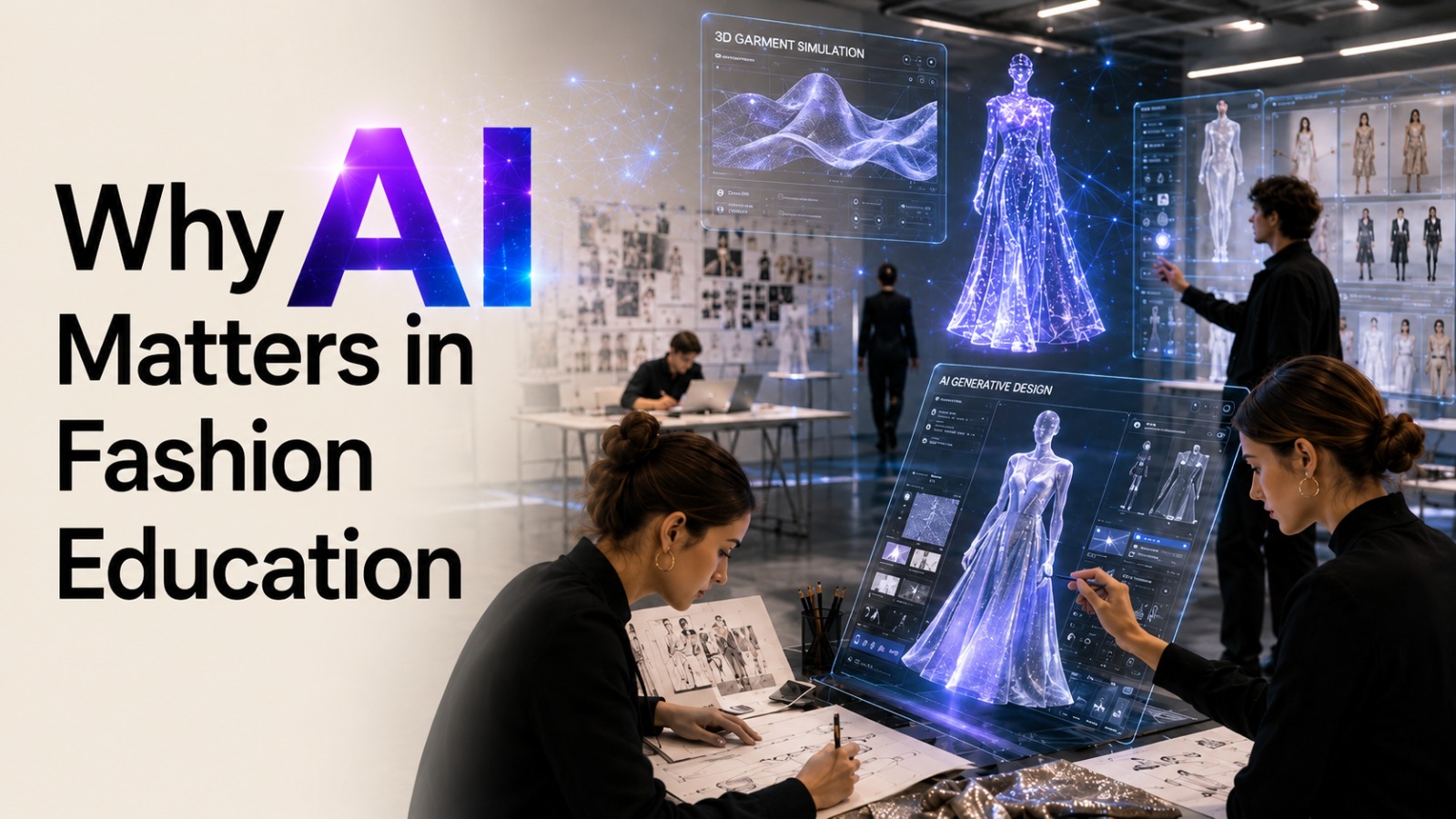
Introduction: Fashion Education Is About to Change Forever
Fashion education has always evolved with technology.
From:
- Hand sketching
- To CAD software
- To digital pattern making
- To 3D fashion tools
Every major shift initially faced resistance.
AI is now the next shift.
And unlike previous transitions, this one is moving extremely fast.
The fashion industry is already changing:
- Content creation is becoming AI-assisted
- Ecommerce is becoming AI-driven
- Marketing is becoming generative
- Virtual experiences are becoming interactive
Yet many fashion schools are still teaching workflows built for a pre-AI world.
That gap is becoming dangerous.
Because the students graduating in the next 2–3 years will enter an industry that already expects AI familiarity.
The question is no longer:
“Should fashion schools teach AI?”
The real question is:
“How quickly can they adapt?”
---
Why AI Matters in Fashion Education
AI is not replacing creativity.
It is changing how creativity is executed, scaled, and commercialized.
This distinction is critical.
Fashion students still need:
- Design thinking
- Aesthetic sensibility
- Styling understanding
- Brand awareness
- Trend interpretation
But now they also need:
- AI-assisted workflows
- Prompt-based creative direction
- Digital content generation skills
- AI visualization understanding
Because the industry itself is evolving.
---
The Industry Has Already Started Moving
Fashion brands are already using AI for:
- Campaign generation
- AI fashion models
- Ecommerce visuals
- Trend research
- Virtual try-ons
- Content scaling
Agencies are adapting.
D2C brands are adapting.
Luxury brands are experimenting.
Students entering the workforce without AI literacy will immediately face a gap.
---
The Biggest Misunderstanding About AI in Fashion
Many people assume AI reduces creativity.
In reality:
AI reduces repetitive execution.
That changes everything.
Before AI
A student might spend:
- Days organizing shoots
- Hours editing images
- Weeks creating campaign variations
With AI
The same student can:
- Generate concepts instantly
- Explore multiple visual directions
- Create portfolio-quality content faster
This increases experimentation.
And experimentation is one of the most important drivers of creativity.
---
Why Fashion Schools Cannot Ignore This Shift
1. The Industry Will Expect These Skills
The same way:
- Photoshop became expected
- Illustrator became expected
- CLO3D became valuable
AI tools will become standard workflow tools.
Students who understand them will have an advantage in:
- Hiring
- Freelancing
- Entrepreneurship
- Portfolio quality
---
2. Students Are Already Learning AI Outside Classrooms
This is already happening.
Students are:
- Experimenting with generative AI
- Using AI image tools
- Learning through YouTube and social media
If institutes do not guide this properly:
- Learning becomes fragmented
- Quality becomes inconsistent
- Ethical understanding is missing
Fashion schools should lead this transition, not react to it later.
---
3. AI Dramatically Improves Portfolio Creation
One of the biggest challenges for fashion students is production access.
Professional shoots are expensive.
AI changes this.
Students can now:
- Visualize collections professionally
- Create campaign concepts
- Build lookbooks
- Present ideas with high production quality
Without requiring large budgets.
This democratizes presentation quality.
---
What Fashion Schools Should Actually Teach
This is important.
Fashion education should not become “AI-only.”
The goal is not to replace design fundamentals.
The goal is to combine:
- Creative thinking
- Fashion understanding
- AI execution
---
Key AI Skills Fashion Students Should Learn
1. AI Fashion Visualization
Understanding:
- AI-generated model imagery
- Styling control
- Mood creation
- Fashion storytelling
---
2. Prompt Thinking
Prompting is becoming a new creative skill.
Students must learn:
- Visual direction prompts
- Styling prompts
- Campaign prompts
- Brand-tone prompts
---
3. AI-Assisted Content Creation
Creating:
- Campaign visuals
- Social media content
- Ecommerce assets
- Digital portfolios
---
4. Ethical AI Usage
This is critical.
Fashion institutes should teach:
- Copyright awareness
- Responsible generation
- Representation and bias
- Authenticity considerations
---
5. AI + Fashion Business Workflows
Students should understand how AI impacts:
- Ecommerce
- Fashion marketing
- Brand operations
- Consumer engagement
Because modern designers increasingly need commercial awareness.
---
The Rise of the AI-Native Fashion Designer
A new type of designer is emerging.
Not just:
“Creative”
But:
- Fast
- Technologically fluent
- Multi-disciplinary
- Content-aware
This designer can:
- Create concepts
- Visualize instantly
- Test ideas quickly
- Build digital-first fashion brands
Fashion education must prepare students for this reality.
---
AI Does Not Replace Fashion Schools. It Makes Them More Powerful.
This is where many institutions misunderstand the opportunity.
AI is not a threat to fashion education.
It is an expansion layer.
Institutes that adopt AI early can:
- Modernize curriculum
- Attract forward-thinking students
- Improve placement relevance
- Build stronger industry partnerships
The schools that adapt early will become innovation leaders.
The ones that delay risk becoming outdated.
---
Why This Matters for Fashion Careers
The next generation of fashion jobs will increasingly value:
- Digital adaptability
- AI-assisted workflows
- Content scalability
- Visual communication speed
Students who understand both:
- Fashion fundamentals
- AI systems
Will become significantly more competitive.
---
Where Platforms Like Glamore.ai Fit In
Fashion-specific AI platforms are making this transition practical.
Tools like Glamore.ai enable:
- AI-generated fashion visualization
- Digital campaign creation
- AI-assisted portfolio development
- Fashion content experimentation
This gives students hands-on exposure to real-world industry workflows.
---
FAQs
Why should fashion students learn AI?
Because AI is becoming part of modern fashion workflows including content creation, ecommerce, and marketing.
Will AI replace fashion designers?
No. AI assists execution but creativity, storytelling, and design thinking remain human-driven.
What AI skills are useful for fashion students?
AI visualization, prompt creation, digital content generation, and AI-assisted campaign design.
Should fashion institutes teach AI officially?
Yes. Structured education helps students use AI effectively, creatively, and ethically.
Is AI important for fashion careers in 2026?
Increasingly yes. Many brands now expect familiarity with AI-driven workflows.
---
Final Thought
Fashion education is entering a new era.
The future designer will not just sketch.
They will:
- Generate
- Visualize
- Experiment
- Scale ideas digitally
The schools that embrace this shift early will shape the next generation of fashion talent.
The rest will spend the next decade trying to catch up.