From Photoshoots to a Fashion OS: How AI Is Rewriting Fashion Content
Fashion and beauty content is moving beyond expensive, one-time photoshoots. Discover how AI is helping brands generate, personalise and scale visual content through an always-on Fashion OS.
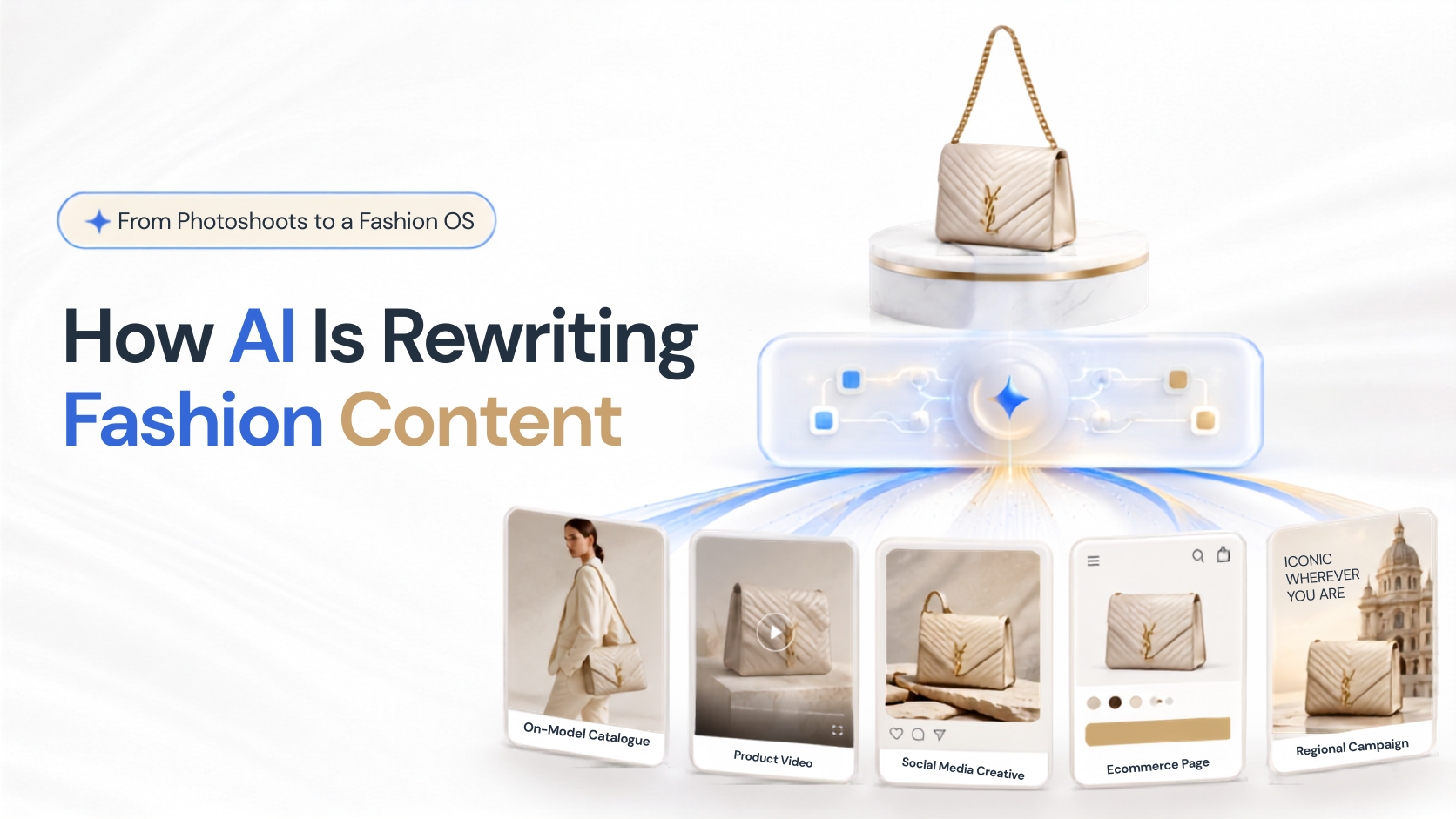
From Photoshoots to an Always-On Fashion OS
Fashion and beauty have always been driven by visual storytelling.
A powerful product image does more than display a garment, accessory or beauty product. It allows shoppers to imagine how that product could look, feel and fit into their own lives.
For decades, creating this moment depended on the traditional photoshoot.
Brands needed models, studios, photographers, stylists, makeup artists, production teams and extensive post-production. The final output could be beautiful, but the process was expensive, time-consuming and difficult to repeat across every product in a growing catalogue.
Today, AI is beginning to remove that limitation.
Fashion and beauty brands can now generate on-model imagery, product videos and campaign variations using their existing assets. What previously required weeks of production can increasingly be created, reviewed and adapted within a much shorter timeframe.
However, this transformation is not simply about producing cheaper images.
It represents a much bigger shift—from treating content as a series of individual projects to managing it as an always-on operating system.
That is the idea behind the Fashion OS.
The complete Fashion OS Playbook by Glamore.ai explores this transformation in greater depth. This blog offers a glimpse into why the shift matters and how brands can begin preparing for it.
Download the complete Fashion OS Playbook: https://drive.google.com/file/d/1cCIF59Bk2jF_6tExzKoxS-5oRowpYkpP/view?usp=drive_link
The Photoshoot Was Never the Final Goal
The photoshoot was always the production method.
The real goal was the final image and the emotion it created for the shopper.
A customer sees a product, imagines themselves wearing or using it and begins to form a connection with it. That moment of imagination is what strong fashion and beauty content is designed to create.
Traditional production, however, placed natural limits on how frequently brands could create that moment.
Most businesses had to prioritise their content investments.
Hero products received premium campaign photography. Lower-priority products were often presented using flat-lays, basic catalogue images or repeated creative assets. The same limited group of images might then be reused across multiple markets, channels and customer segments.
For many brands, the content strategy was silently controlled by one question:
What can we afford to shoot?
AI introduces a more ambitious question:
What could we create if high-quality content was available whenever we needed it?
This changes more than the production budget. It changes how brands can plan, create, personalise and distribute content.
Why One-Time Content Production Is Becoming a Limitation
Traditional fashion content production generally follows a fixed process:
Brief → Production → Photoshoot → Editing → Approval → Publishing
Once the campaign ends, the process begins again.
This model can still work for major brand campaigns, but it becomes increasingly difficult when businesses need content for:
- Every product and colourway
- Multiple e-commerce platforms
- Different social-media formats
- Performance marketing campaigns
- Regional and international markets
- Frequent product launches
- Seasonal moments
- Personalised customer communication
A single product may need a vertical video for social media, a clean product image for an e-commerce page, a horizontal banner for advertising and a localised visual for a specific market.
Producing each asset through a separate manual workflow is slow and expensive.
A Fashion OS approaches this differently.
Instead of treating every image or video as a completely new production project, brands create a connected system that can continuously generate, personalise, review and publish content.
One approved product asset could support multiple outputs:
- On-model catalogue imagery
- Product-page videos
- Social-media content
- Digital advertisement variations
- Market-specific campaigns
- Customer-segment creatives
- Seasonal visual adaptations
The opportunity is not simply to create more content.
It is to create relevant, consistent and measurable content across the entire customer journey.
The Catalogue Is One of the Biggest Opportunities
Many fashion and beauty brands manage hundreds or thousands of products, shades, variants and colourways.
Producing premium model imagery for every item can be operationally and financially challenging.
As a result, visual quality often varies across the catalogue.
A small number of hero products may receive strong campaign photography, while the remaining products are supported by limited or inconsistent imagery. This can affect product discovery, customer confidence and the overall shopping experience.
AI-generated on-model imagery can help brands improve catalogue coverage using:
- Product flat-lays
- Existing product photographs
- Brand reference images
- Approved model profiles
- Defined visual guidelines
- Campaign art direction
The goal is not to generate random images at scale.
The goal is to create controlled, product-accurate and brand-consistent visual content for a much larger portion of the catalogue.
This means premium visual storytelling no longer needs to be limited to a few selected products.
A brand could begin with one poorly covered category, create consistent on-model imagery for every product in that category and measure the effect on engagement, conversion and production speed.
The catalogue then becomes more than a collection of product listings.
It becomes a continuously evolving content library.
AI Is Turning Shopping into a More Participatory Experience
Traditional e-commerce content is mainly passive.
A shopper sees a product image, reads the description and decides whether they are interested.
AI-powered experiences can make this journey more interactive.
Virtual try-on is one example.
Instead of only looking at a product on a model, customers can begin to visualise how it might look on themselves. This can reduce some of the uncertainty associated with online shopping and create a stronger sense of participation.
The Fashion OS Playbook highlights industry research suggesting that virtual try-on users can demonstrate stronger engagement, conversion and retention than shoppers who do not use the experience.
These results should not be treated as guaranteed outcomes for every company. Performance will depend on the product category, implementation quality, customer experience and accuracy of the technology.
However, they point towards an important behavioural shift:
Customers are more likely to engage when they can participate in the product experience instead of simply observing it.
This is especially valuable in categories where fit, appearance, shade, styling or personal preference heavily influence the buying decision.
One Product Can Now Tell Many Stories
Traditional campaigns are usually built around one central creative direction.
The main campaign visual may be resized or slightly modified for different platforms, but the same creative is often shown to audiences across multiple locations and customer groups.
AI makes it possible to think differently.
A single product can be presented through multiple relevant stories while maintaining product accuracy and brand consistency.
For example, the same fashion product could be shown through:
- Different regional environments
- Diverse model profiles
- Seasonal settings
- Platform-specific compositions
- New-customer campaigns
- Repeat-customer campaigns
- Different lifestyle contexts
A beauty product could be adapted for multiple shades, skin tones, customer groups or campaign moments.
This is not personalisation simply for the purpose of generating more assets.
It is about making the content more relevant to the person seeing it.
A shopper may connect more strongly with a visual that reflects their style, location or needs than with one generic campaign image designed for everyone.
When creative relevance improves, content becomes more useful—not merely more abundant.
AI Video Can Move Beyond Major Campaigns
Video has become one of the most important formats for product discovery.
Customers encounter videos across social media, advertisements, product pages, marketplaces, email campaigns and e-commerce platforms.
However, traditional video production can require even more time and resources than still photography.
This often means brands reserve video for major campaigns, best-selling products and seasonal launches.
AI can help transform existing product images into short-form motion content. This creates an opportunity to produce video for a much larger portion of the catalogue.
A still product image could potentially become:
- A social-media reel
- A product-detail animation
- A campaign teaser
- A marketplace video
- A digital advertisement
- A styling or product showcase clip
The opportunity is to make video a repeatable catalogue capability rather than an occasional production event.
Creative direction and quality control will still remain essential. AI simply allows those ideas to be executed across more products, platforms and formats.
Using More AI Tools Does Not Automatically Create a Strategy
Brands are rapidly experimenting with AI tools for imagery, video, writing, design, personalisation and analytics.
Experimentation is useful, but a growing collection of disconnected tools can create new challenges.
Different platforms may generate inconsistent visual styles. Assets may need to be transferred manually between multiple systems. Approval processes can become unclear, and performance data may remain disconnected from the creative.
A strong AI content strategy should not be judged by the number of tools a company uses.
It should be judged by how effectively the capabilities work together.
A Fashion OS connects the most important parts of the workflow:
Brief → Generate → Review → Approve → Personalise → Publish → Measure
This creates a more governed and repeatable content operation.
The competitive advantage will not necessarily belong to the brand using the highest number of AI tools.
It will belong to the brand that can consistently produce relevant, accurate and on-brand content at scale.
Creative Teams Will Remain at the Centre
AI does not make creative teams less important.
It changes where their time and expertise can create the greatest value.
Traditional production often requires creative professionals to spend significant time on repetitive execution, coordination and asset adaptation.
AI can reduce some of this production burden and give teams more space to focus on:
- Brand direction
- Art direction
- Campaign concepts
- Visual storytelling
- Customer insights
- Cultural relevance
- Quality control
- New creative formats
AI can generate multiple visual options, but it still requires a clear point of view.
Without strong creative direction, generating more content may only create more inconsistency.
The strongest AI-native brands will combine machine-enabled production with human judgement, strategy and taste.
Governance Must Grow Alongside Content Generation
The ability to produce content faster also introduces important responsibilities.
Fashion and beauty brands need clear guidelines covering:
- Model likeness and consent
- Product accuracy
- Intellectual-property rights
- Ownership of generated content
- Licensed reference assets
- Brand safety
- Review and approval
- AI disclosure
These questions should be addressed before content begins scaling.
For example, an AI-generated image should not misrepresent a product’s colour, material, fit, texture or performance.
A visually impressive image that creates inaccurate customer expectations can damage trust and contribute to higher returns.
The objective should be to increase speed without reducing authenticity.
A well-designed Fashion OS combines generation with governance. It enables brands to scale content while maintaining legal clarity, quality standards and brand consistency.
Start with One Category and One Clear Goal
Building an AI-native content system does not require transforming the entire organisation immediately.
A focused pilot is often the strongest place to begin.
Brands can identify one category that has:
- Limited on-model imagery
- A high number of products
- Strong commercial potential
- Frequent launches
- High production costs
- A need for more videos
- Customer uncertainty around fit or appearance
The next step is to define one measurable goal.
That goal could be:
- Improving catalogue coverage
- Reducing production time
- Increasing product-page engagement
- Testing virtual try-on
- Producing videos for more products
- Creating localised campaign assets
The pilot should then be measured against clear creative, operational and commercial metrics.
A successful workflow can gradually be expanded across more categories, platforms and markets.
The objective is not to create one impressive AI-generated image.
It is to develop a repeatable process that continues creating value.
The Future Belongs to Content Systems
Fashion and beauty will always require imagination, emotion and visual excellence.
AI does not change that.
What it changes is the speed and scale at which brands can bring creative ideas to life.
The future will not necessarily be defined by choosing between traditional photography and AI-generated content.
Most brands will continue to use a combination of both.
Major campaigns may still involve physical photoshoots. AI can then help extend those campaigns across more products, audiences, markets and content formats.
The larger shift is from thinking about content as a limited collection of completed assets to thinking about it as a living system.
A system that can:
- Generate
- Adapt
- Personalise
- Distribute
- Measure
- Improve
That is the opportunity behind the Fashion OS.
Explore the Complete Fashion OS Playbook
This blog provides only a glimpse into the ideas shaping AI-native fashion and beauty content.
The complete Fashion OS Playbook by Glamore.ai explores the market opportunity, content capabilities, practical frameworks and implementation approaches brands can use to move from isolated AI experiments towards a connected content system.
Download the complete Fashion OS Playbook: https://drive.google.com/file/d/1cCIF59Bk2jF_6tExzKoxS-5oRowpYkpP/view?usp=drive_link
---
Build Your Fashion OS with Glamore.ai
Glamore.ai helps fashion and beauty brands generate powerful on-brand images and videos, personalise content for different markets and audiences, and scale creative production across their complete product catalogue.
Bring your products, assets and creative vision.
Glamore.ai brings them to life at scale.
Explore Glamore.ai