The Human Premium: Why Fashion Brands May Become More Valuable by Showing What AI Did Not Make
As AI-generated fashion content becomes common, craftsmanship, provenance and visible human effort may become more valuable. Discover how fashion brands can use AI for scale while protecting authenticity, creativity and human connection.
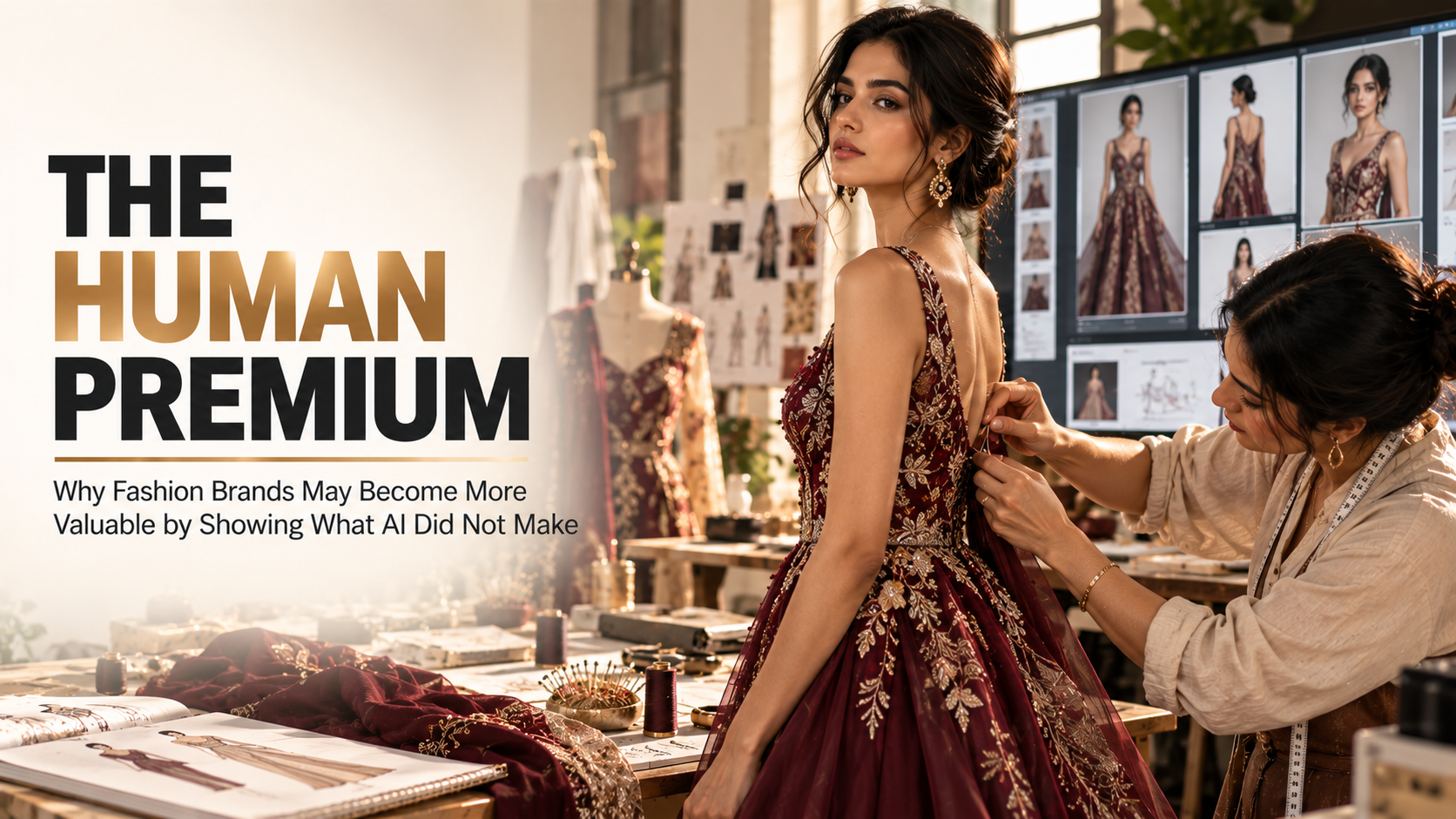
Introduction: When Everything Can Be Generated, What Becomes Valuable?
Fashion is entering an unusual moment.
Artificial intelligence is making it dramatically easier to create.
Images can be generated in seconds.
Videos can be produced without a full shoot.
Campaign concepts can be explored instantly.
Product descriptions can be written at scale.
Entire content libraries can be produced with a fraction of the time and cost previously required.
For fashion brands, this is a huge opportunity.
But something else is happening at the same time.
As AI-generated content becomes more common, consumers are beginning to value signals that something required genuine human effort.
- Hand finishing
- Craftsmanship
- Imperfection
- Original photography
- An artisan’s signature
- A designer’s sketch
- A real creative process
Vogue recently described this emerging behaviour as “effort signaling”: brands deliberately showing the time, skill and human work behind what they create as a counterweight to increasingly synthetic digital culture.
This does not mean fashion is turning against AI.
It means a new equation is emerging:
> AI creates scale. Human effort creates meaning.
The brands that understand both may become much stronger than brands that choose only one.
---
What Is the Human Premium in Fashion?
The human premium is the additional emotional, cultural or commercial value customers place on products and experiences that clearly demonstrate human creativity, skill, judgment or effort.
It can appear through:
- Handcrafted details
- Artisan techniques
- Founder stories
- Designer involvement
- Real photography
- Original illustration
- Visible production processes
- Limited production
- Personal service
- Human imperfections
The more digital production becomes automated, the more these signals can stand out.
Scarcity changes value.
When perfect imagery was expensive, perfection signaled quality.
When perfect imagery becomes available to everyone, perfection alone may become less distinctive.
What becomes scarce instead?
> Humanity.
---
Why AI Is Creating This Countertrend
AI dramatically reduces the cost of producing polished content.
That democratizes creativity.
A startup can now create campaign imagery that once required a much larger budget.
This is positive.
But it also creates a new problem.
If every brand can generate:
- Perfect models
- Perfect locations
- Perfect lighting
- Perfect skin
- Perfect videos
Then visual perfection stops being a competitive advantage.
Customers may begin asking a different question:
> “Is any of this real?”
That is why authenticity and provenance are becoming strategically important.
Recent fashion campaigns have increasingly emphasized process, craft and human creativity.
Vogue has highlighted brands such as Chanel, Dior, Loewe and Hermès among those leaning into labor-intensive craft and artisanal storytelling as AI-generated aesthetics become more widespread.
[Read the Vogue article](https://www.vogue.com/article/how-effort-signaling-became-fashions-antithesis-to-ai)
---
Fashion Has Always Sold More Than the Product
Luxury has understood this for decades.
A handbag is not valuable simply because it holds things.
A couture dress is not valuable simply because it covers the body.
The value includes:
- Who designed it
- How it was made
- Where it was made
- How long it took
- Who worked on it
- What tradition it represents
AI does not eliminate these dimensions.
It may make them more important.
When digital production becomes nearly infinite, physical creation remains finite.
That contrast can increase perceived value.
---
The Rise of “Effort Signaling”
In traditional luxury, craftsmanship was often communicated subtly.
Today, brands may need to show it more explicitly.
That could mean:
- Behind-the-scenes atelier footage
- Artisan interviews
- Hand-finishing videos
- Design sketches
- Material sourcing stories
- Production timelines
- Repair and restoration content
- Real people making real products
The work itself becomes marketing.
Vogue has also reported renewed interest in craft, repair, sewing and upcycling among younger consumers, with brands responding through workshops, DIY programs and visible making processes.
[Read more on Vogue](https://www.vogue.com/article/customers-are-crafting-more-should-brands-get-involved)
---
Why Imperfection May Become an Advantage
AI naturally pushes visual culture toward polish.
Perfect faces.
Perfect symmetry.
Perfect lighting.
But humans are not perfect.
That may increasingly become part of the appeal.
- A slight wrinkle in fabric
- Skin texture
- An unpolished workshop
- A hand-drawn line
- A spontaneous expression
These signals can communicate reality.
This does not mean deliberately making bad content.
It means brands may benefit from preserving some evidence that real people exist behind the work.
---
The Wrong Response: Become Anti-AI
There is a danger here.
Some brands may conclude:
> “Consumers want authenticity, so we should avoid AI.”
That misses the point.
AI is extraordinarily useful.
It can reduce repetitive production.
It can scale creative variations.
It can help small teams operate faster.
It can generate images, videos, copy and localized campaigns.
Rejecting all of that would be commercially irrational for many brands.
The better approach is to decide:
> Where should AI create efficiency?
And:
> Where should human involvement create value?
---
A Simple Rule: Automate Repetition, Protect Distinction
This may be one of the easiest principles for fashion companies to follow.
Use AI heavily for:
- Background variations
- Resizing
- Catalog extensions
- Routine product imagery
- Video variations
- Localization
- Copy adaptations
- Research
- Reporting
- Repetitive production
Keep strong human involvement in:
- Brand point of view
- Original product design
- Creative direction
- Cultural judgment
- Craftsmanship
- Founder voice
- Hero campaigns
- Storytelling
- Relationship-building
AI should scale the brand’s point of view.
> It should not become the brand’s point of view.
---
What This Means for Small Fashion Brands
The human premium may actually benefit startups.
Large brands can outspend a startup.
They can buy more media.
Hire bigger agencies.
Book famous models.
But startups often possess things large companies struggle to manufacture:
- Founder intimacy
- Local stories
- Genuine community
- Visible making
- Direct customer relationships
- Authentic origin stories
AI lets the startup compete on production quality.
Human authenticity lets it remain distinctive.
That combination can be extremely powerful.
---
Show the Making, Not Just the Finished Product
One of the most practical changes brands can make is to document more of the process.
If a garment takes eight hours to embroider, show it.
If an artisan uses a traditional technique, show it.
If a designer goes through 20 sketches before selecting one silhouette, show it.
If fabric is sourced from a particular community or mill, explain why.
AI can make the final campaign beautiful.
But the process creates the story.
---
Provenance Will Become a Marketing Asset
As synthetic content becomes easier to create, customers may increasingly want to know where things came from.
Provenance means documenting origin.
- Who made it?
- Where?
- Using what materials?
- Through what process?
The concept of “handmade” itself is becoming more scrutinized, with industry efforts increasingly focused on verifying what claims of craftsmanship actually mean.
[Read more on Vogue](https://www.vogue.com/article/what-does-handmade-actually-mean)
Brands should therefore avoid vague craft-washing.
If something is handmade, explain exactly which stage is handmade.
If machines are involved, say so.
Transparency strengthens trust.
---
AI Content Should Not Pretend to Be Reality When Reality Matters
AI-generated fashion imagery can be extremely useful.
But brands should think carefully about context.
If an image is simply inspirational campaign creative, AI may be perfectly appropriate.
If the customer relies on that image to understand exact:
- Fit
- Colour
- Fabric
- Construction
- Product detail
Then accuracy becomes critical.
This is where a human-in-the-loop workflow matters.
AI content should help customers understand products.
It should not create expectations the actual product cannot meet.
---
The Human Premium Applies to People Too
The same principle applies beyond products.
Customers may increasingly value access to real:
- Designers
- Stylists
- Founders
- Craftspeople
- Store associates
AI can handle routine support.
But a premium customer may still value talking to a real stylist.
AI can generate thousands of campaign variations.
But hearing the designer explain why the collection exists can create a very different emotional connection.
Automation can make human interaction more valuable by making it more scarce and more intentional.
---
Real Models and AI Models Can Coexist
This does not need to become a debate about replacing models.
AI models are useful for:
- Catalog scale
- Fast content production
- Localization
- Testing
- Product variations
Real models bring:
- Personality
- Celebrity
- Cultural relevance
- Authentic movement
- Human connection
A sophisticated fashion brand can use both.
Use AI models where scale matters.
Use real people where human connection matters.
The question is not:
> AI or human?
It is:
> Which creates more value in this moment?
---
The Same Applies to Photography
Fashion photographers are already adapting to AI entering commercial workflows for backgrounds, storyboarding, mock-ups and post-production.
Vogue has documented this shift and the tension it creates within the creative industry.
[Read the Vogue article](https://www.vogue.com/article/ai-is-everywhere-fashion-photographers-are-being-forced-to-adapt)
The photographer does not necessarily disappear.
The role changes.
A photographer may increasingly become:
- Visual director
- Storyteller
- AI collaborator
- Brand-world builder
Technical execution becomes easier.
Taste becomes more valuable.
---
The New Luxury May Be Proof of Effort
For decades, luxury communicated scarcity through price, materials and distribution.
The next layer may be proof of effort.
Imagine two products.
Product A
> “Premium embroidered jacket.”
Product B
> “This jacket passes through six artisans. The embroidery takes approximately 14 hours and is completed by hand using a technique practiced in the region for generations.”
The physical product may be similar.
The perceived meaning is very different.
AI can help tell that story.
It cannot manufacture the history behind it.
---
A Practical Human Premium Framework
Fashion brands can review their business across four layers.
1. What Should AI Scale?
Identify repetitive production where customers do not pay a premium for manual effort.
2. What Should Humans Own?
Identify places where taste, judgment, relationships or craftsmanship create differentiation.
3. What Human Effort Should Be Made Visible?
Many brands already possess incredible craft stories but fail to communicate them.
4. Where Should the Two Work Together?
The strongest workflows may combine both.
An artisan creates the product.
AI creates 50 localized content variations telling that artisan’s story.
Human value remains at the core.
AI scales its reach.
---
How This Could Change Fashion Content Strategy
A future content calendar might deliberately mix:
AI SCALE CONTENT
- Product variations
- Catalog imagery
- Automated video
- Localized content
With:
HUMAN PROOF CONTENT
- Workshop stories
- Founder videos
- Designer sketches
- Artisan profiles
- Behind-the-scenes footage
- Real customer stories
The tension between the two can actually strengthen the brand.
---
What About Brands Without Handmade Products?
The human premium is not limited to craft labels.
A D2C streetwear brand can show:
- Founder thinking
- Community
- Cultural inspiration
- Design process
- Real customer stories
A sportswear brand can show:
- Athletes
- Product testing
- Design decisions
- Performance research
A fast-fashion startup can show:
- Team personality
- Creative process
- Responsible sourcing decisions
Human value is not only about hand embroidery.
It is about human intention.
---
Why This Matters for Trust
AI creates enormous opportunity.
It also creates uncertainty.
Customers increasingly need signals that help them decide:
- Is this brand real?
- Is this product real?
- Is this claim credible?
- Who stands behind it?
Brands that combine advanced AI with transparency can build stronger trust than brands pretending AI does not exist or brands automating everything without explanation.
---
Where Glamore.ai Fits
At Glamore.ai, we believe AI should make fashion brands more creative and more capable.
Not more generic.
AI-generated fashion models, imagery, video and enterprise intelligence can dramatically improve the economics of content creation.
But the technology should serve the brand.
The brand should not start looking like the technology.
Our approach is therefore built around an important idea:
> Use AI for scale. Keep humans in charge of taste, truth and identity.
The opportunity is not to remove human creativity from fashion.
It is to give human creativity much greater reach.
---
Frequently Asked Questions
Will AI-generated fashion content replace real photography?
AI will replace or augment some routine production, but real photography is likely to remain valuable for hero campaigns, storytelling, cultural relevance and situations where authenticity matters.
What is effort signaling in fashion?
Effort signaling is the practice of deliberately showing the human skill, time, craftsmanship or creative process behind a product or campaign to communicate authenticity and value.
Why is craftsmanship becoming more important in the AI era?
As polished digital content becomes easier and cheaper to generate, genuine craft and human effort become relatively scarcer and therefore potentially more distinctive.
Should fashion brands disclose AI-generated content?
Disclosure expectations vary by market and context, but transparency is increasingly important. Brands should also ensure AI content does not misrepresent the actual product.
Can small fashion brands benefit from the human premium?
Yes. Founder stories, local production, direct customer relationships, community and visible creative process can help smaller brands differentiate without large advertising budgets.
Is using AI bad for brand authenticity?
Not inherently. Authenticity depends on how AI is used. AI can scale a genuine brand story just as easily as it can create generic content.
What should fashion brands never automate completely?
Areas involving core creative identity, cultural judgment, important relationships, product truth and high-impact brand decisions should retain meaningful human oversight.
---
Final Thought: Humanity Becomes More Valuable When It Is No Longer Required
Technology has always changed fashion.
The sewing machine changed production.
Photography changed communication.
Ecommerce changed distribution.
AI is changing creation itself.
But every technological shift also changes what people value.
When production becomes faster, slowness can become luxury.
When perfection becomes easy, imperfection can feel authentic.
When content becomes infinite, meaning becomes scarce.
And when machines can create almost anything, the knowledge that a human chose to create something may become more valuable.
The future of fashion does not belong to AI alone.
Nor does it belong to brands that resist technology.
It belongs to brands that understand what machines should do exceptionally well and what humans should continue to make meaningful.