From Personalization to Individualization: How AI Will Create a Different Fashion Store for Every Shopper
AI is moving fashion ecommerce beyond traditional personalization toward individualization, where every shopper can experience a different storefront, product discovery journey, imagery, styling and content based on their unique intent and preferences.
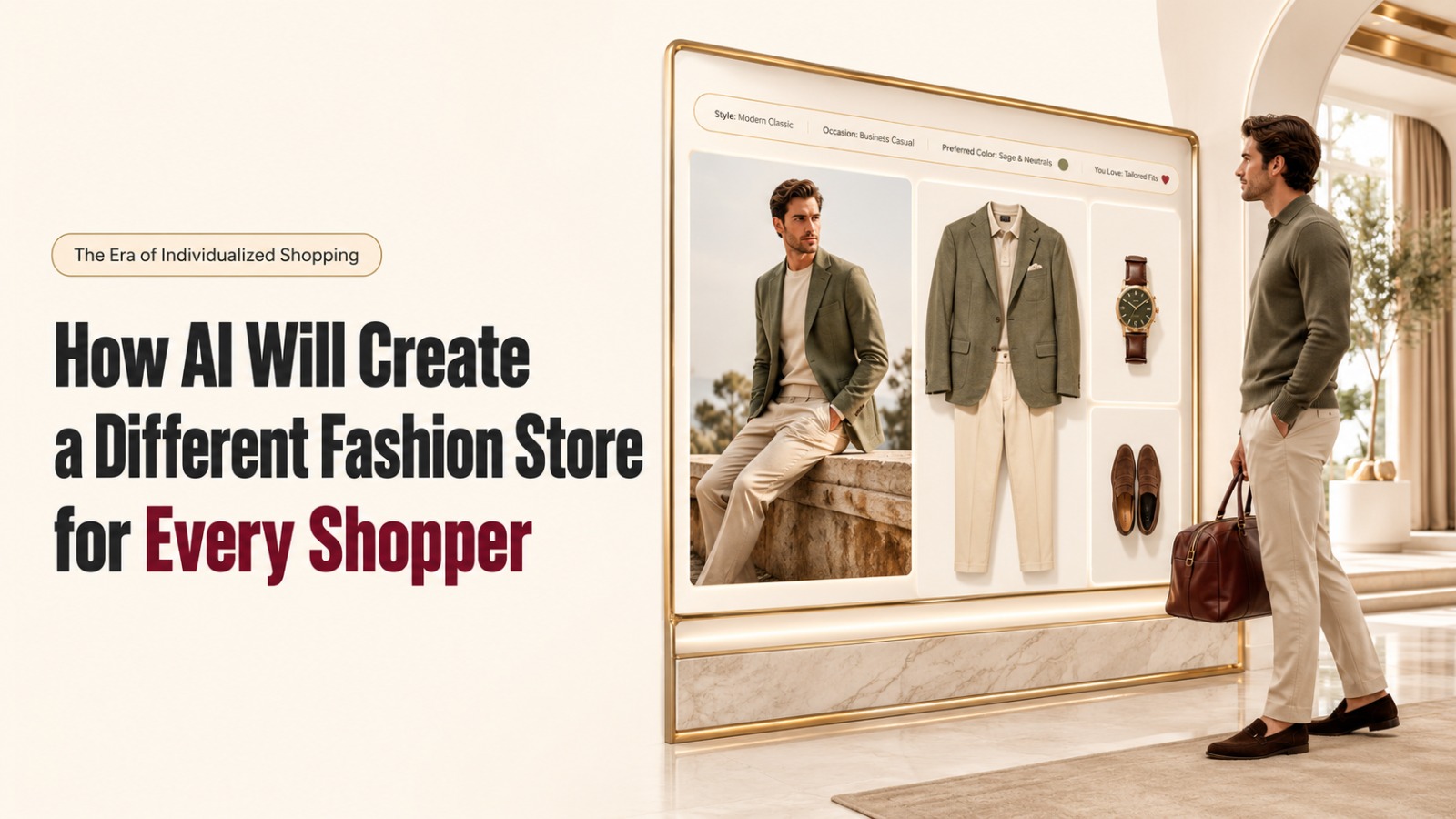
Introduction: The Same Store for Everyone Is Becoming Obsolete
For most of ecommerce history, every shopper walked into essentially the same digital store.
The homepage was the same. The product grid was the same. The campaign banners were the same. The models wearing the clothes were the same.
Brands eventually added personalization.
Recommended products. Recently viewed items. Targeted emails. Customer segments.
Useful improvements, but still limited.
The next phase is much bigger.
Artificial intelligence is moving fashion ecommerce from personalization to individualization, where the entire shopping experience can adapt to the person in real time.
Instead of asking, “Which products should we recommend to this customer?”
Fashion brands will increasingly ask:
“What should this customer’s version of our store look like right now?”
That shift could fundamentally change online fashion retail.
What Is AI Personalization in Fashion Ecommerce?
AI personalization in fashion ecommerce is the use of artificial intelligence and machine learning to adapt a shopper’s experience based on signals such as browsing behaviour, purchase history, product interactions, style preferences, context and real-time intent.
Traditional personalization usually depends on predefined rules.
For example:
If a customer bought running shoes, show sportswear.
If a customer is in Mumbai, show summer products.
AI personalization is more dynamic.
It can analyse many signals simultaneously and adjust what the shopper sees as those signals change.
In fashion, this matters because buying decisions are unusually personal.
A shopper is not simply choosing a product.
They are asking:
Will this suit me? Will this fit my style? Can I wear it for this occasion? Does this feel like me?
That is why fashion personalization cannot stop at “people who bought this also bought that.”
Personalization vs Individualization
The difference is important.
Personalization
A brand groups customers into segments and adapts parts of the experience.
For example:
- Men vs women
- New vs returning customers
- Luxury vs value shoppers
- Casualwear vs occasionwear audiences
Individualization
The experience adapts at the level of one person.
Two customers visiting the same website at the same moment may see:
- Different hero images
- Different models
- Different product rankings
- Different outfits
- Different videos
- Different copy
- Different recommendations
- Different offers
The website effectively becomes a different store for every shopper.
Why Fashion Is Especially Suited to AI Individualization
Fashion is not a purely functional purchase.
It is connected to identity, aspiration, occasion, body type, climate, culture and personal taste.
This creates a much richer personalization opportunity than many other retail categories.
A shopper looking for a black dress might mean:
A work dress. A date-night dress. A wedding guest outfit. A modest evening dress. A minimalist luxury piece. A budget party dress.
The search term is identical.
The intent is completely different.
AI can increasingly interpret that context.
The Storefront Will Become Dynamic
Today, ecommerce teams spend weeks planning homepages and campaign pages.
Tomorrow, many of those surfaces may be assembled dynamically.
Imagine a customer who frequently buys neutral linen clothing.
The homepage could automatically lead with:
- Neutral palettes
- Resortwear
- Linen collections
- Models styled in understated looks
- Destination-led content
Another customer visiting the same brand may prefer bold eveningwear.
Their version of the homepage could lead with:
- Statement dresses
- High-contrast imagery
- Party styling
- Short-form videos
- New-arrival accessories
Same brand.
Different storefront.
Product Discovery Will Become Conversational
Traditional fashion ecommerce relies heavily on menus and filters.
Women > Dresses > Midi > Black > Size M.
But people do not naturally think in filters.
They think in situations.
“I need something elegant for a beach wedding in Goa, but I don’t want anything too formal.”
“I need three outfits for a five-day Dubai trip.”
“Show me workwear that looks premium but is comfortable enough for travel.”
AI shopping assistants can interpret these requests and respond with curated products, complete looks and follow-up questions.
This transforms product discovery from navigation into conversation.
Fashion Imagery Itself Can Become Personalized
This may be one of the most important changes.
Historically, a brand photographed one model wearing one product and showed that same image to every shopper.
Generative AI changes the economics of visual production.
A brand can potentially create multiple visual representations of the same product using different:
- Models
- Body types
- Age groups
- Styling directions
- Backgrounds
- Locations
- Contexts
The result is not just more content.
It creates the possibility of more relevant content.
A shopper may see a dress styled for work.
Another may see the same dress styled for dinner.
Another may see it as part of a travel look.
The product has not changed.
The context has.
Video Will Become Personalized Too
Fashion ecommerce is rapidly becoming more video-led.
Product videos, reels, motion content and AI-generated fashion films are increasingly part of the buying journey.
Generative video adds another layer to personalization.
Instead of producing one video for an entire campaign, brands can create multiple versions based on:
- Geography
- Customer segment
- Occasion
- Language
- Product preference
- Platform
A customer in Mumbai might see one version.
A customer in Dubai could see another.
A first-time shopper may receive an introductory product story.
A repeat buyer may see a styling recommendation.
Creative becomes adaptive rather than fixed.
AI Stylists Will Change How Customers Shop
One of the most natural applications of AI in fashion is styling.
A strong AI stylist could understand:
- What a customer owns
- What they recently purchased
- Their preferred silhouettes
- Colours they repeatedly select
- Their likely size
- Brands they prefer
- Upcoming occasions
- Their budget
Instead of recommending individual products, it can build complete looks.
For the customer, this reduces effort.
For the retailer, it creates opportunities to increase basket size, cross-sell intelligently and build stronger relationships.
Personalization Must Extend Beyond the Website
A truly individualized fashion experience cannot stop at the homepage.
The same intelligence should influence:
Different product edits and creative for different customers.
Paid Advertising
Creative variations matched to different audiences and behavioural signals.
WhatsApp and Messaging
Conversational recommendations based on customer history and intent.
Loyalty
Offers and benefits aligned with actual preferences rather than generic reward campaigns.
Physical Retail
Store associates could eventually access AI-generated customer context and recommendations, with appropriate consent and privacy safeguards.
The customer should feel like they are interacting with one brand, not multiple disconnected systems.
Why Better Data Matters More Than Better AI
There is an important reality behind all this.
AI personalization is only as good as the information available to it.
Fashion brands need clean, structured data around:
- Product attributes
- Size information
- Materials
- Colours
- Fit
- Occasion
- Style
- Inventory
- Customer behaviour
- Content assets
If the underlying information is incomplete or inconsistent, personalization will be unreliable.
This is why the future of fashion AI is not simply about adding more tools.
It is about building a connected intelligence foundation.
The Role of the Fashion AI Brain
This is where an Enterprise Fashion AI Brain becomes powerful.
Instead of every AI tool operating independently, the AI Brain acts as a shared intelligence layer.
It understands:
The brand. The products. The customers. The creative library. The inventory. The historical campaigns. The business rules.
Different AI systems can then use the same intelligence.
The marketing AI knows what the merchandising AI knows.
The ecommerce assistant understands the same product information as customer service.
The creative engine understands brand guidelines and product attributes.
Individualization becomes coordinated rather than fragmented.
What Fashion Brands Should Do Now
Brands do not need to personalize everything immediately.
The smarter approach is to build in stages.
Stage 1: Fix the Data Foundation
Improve product attributes, customer data, content metadata and integrations.
Stage 2: Personalize Product Discovery
Use recommendations, smarter search and customer segmentation.
Stage 3: Introduce Conversational Commerce
Allow customers to express intent naturally rather than relying only on menus and filters.
Stage 4: Personalize Creative
Generate multiple images, videos and campaign variations for different audiences.
Stage 5: Individualize the Storefront
Allow the complete shopping journey to adapt dynamically to each shopper.
The objective is not personalization for its own sake.
It is relevance.
The Trust Question
There is another side to individualization.
Customers need to trust it.
Fashion brands should be transparent about how customer information is used and avoid personalization that feels intrusive.
AI should make shopping easier.
Not unsettling.
The best personalization often feels invisible.
The customer simply thinks:
“This brand understands me.”
Where Glamore.ai Fits
At Glamore.ai, we believe fashion personalization will extend far beyond product recommendations.
As AI-generated images, videos, virtual models, intelligent agents and enterprise knowledge become connected, fashion brands will be able to create far more adaptive digital experiences.
One product can become many visual stories.
One campaign can become hundreds of relevant variations.
One digital store can become millions of individual experiences.
Our broader vision is to help fashion companies build the creative and intelligence infrastructure required for that future, from AI-generated visual content and video to enterprise AI systems that understand the brand, product and customer together.
Frequently Asked Questions
What is AI personalization in fashion ecommerce?
AI personalization uses artificial intelligence and customer signals to adapt product recommendations, search results, content, creative and shopping experiences to individual users.
What is the difference between personalization and individualization?
Personalization usually adapts experiences for customer segments. Individualization uses real-time data and AI to tailor the experience for one specific shopper.
How can AI personalize a fashion website?
AI can change product rankings, recommendations, homepage content, search results, imagery, videos, styling suggestions, offers and conversational shopping guidance based on shopper behaviour and intent.
Can AI create a different ecommerce store for every customer?
Increasingly, yes. Dynamic content, recommendation engines, generative AI and real-time decision systems can combine to create highly individualized storefront experiences.
How does AI personalization improve fashion ecommerce?
When implemented well, it can improve product discovery, relevance, customer confidence, cross-selling and the overall shopping experience. Its effectiveness depends heavily on data quality, trust and execution.
What data is needed for fashion AI personalization?
Useful inputs include structured product attributes, inventory, customer behaviour, purchase history, preferences, content metadata, sizing information and contextual signals.
Will AI personalization replace merchandisers and stylists?
No. AI can automate recommendations and analysis, while human merchandisers and stylists continue to provide taste, judgment, brand understanding and creative direction.
Final Thought
The first era of ecommerce digitized the store.
The second era personalized parts of it.
The next era will individualize the entire experience.
The winners will not necessarily be the brands with the largest catalogue or the biggest advertising budgets.
They will be the brands that can understand each customer’s intent and respond with the most relevant product, story, image, video and experience at that moment.
The future fashion store will not look the same to everyone.
It will look different to you.
And that may become one of AI’s most important contributions to fashion commerce.