Why Fashion Brands Need One AI Foundation, Not 50 AI Tools
Fashion brands are adopting AI across every department, but disconnected tools can create AI fragmentation. Discover why the future of fashion AI depends on one connected intelligence foundation powering specialised AI agents, workflows and business decisions.
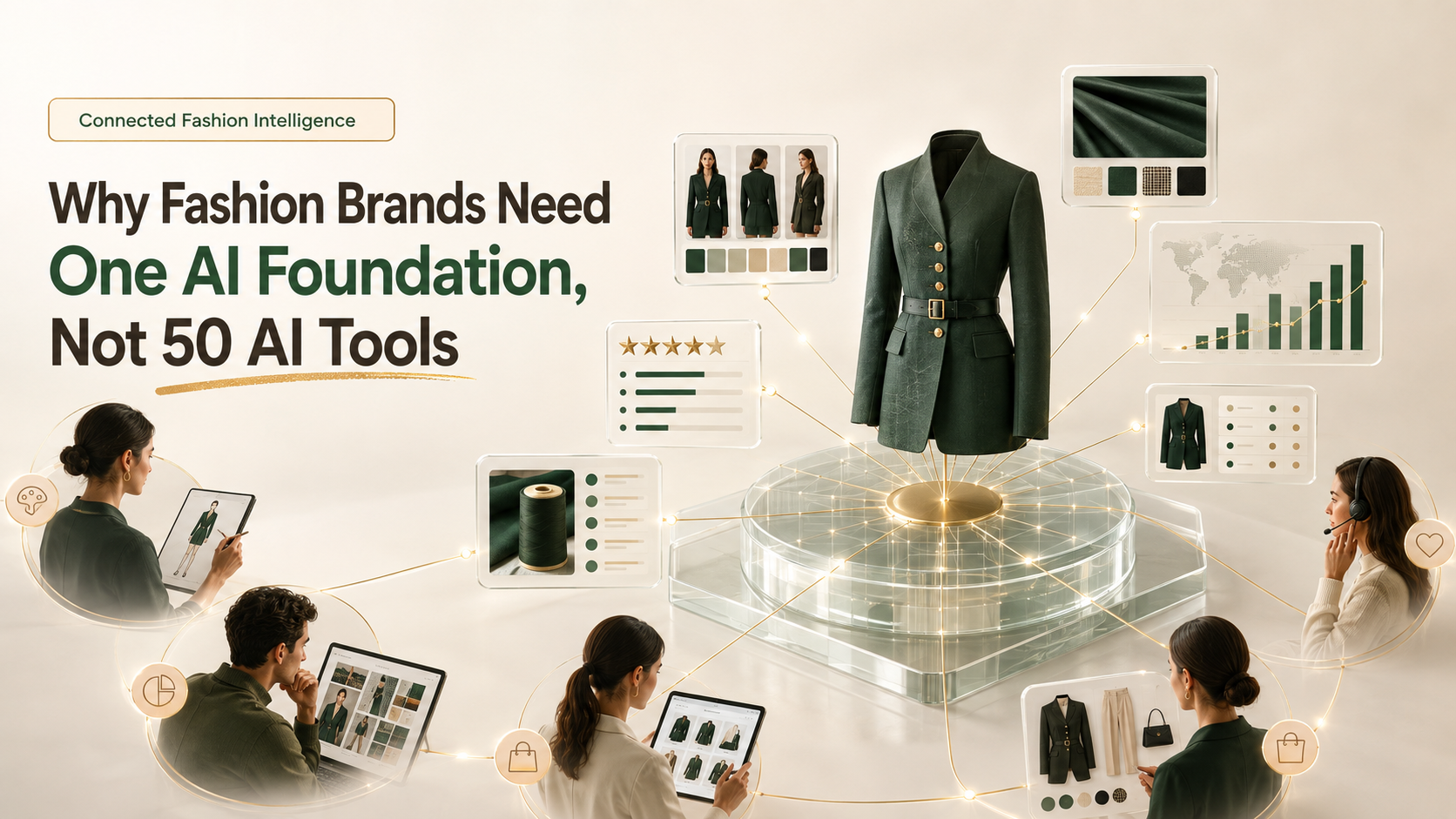
# Why Fashion Brands Need One AI Foundation, Not 50 AI Tools
Introduction: The AI Tool Explosion Is Creating a New Problem
Fashion companies are adopting AI quickly.
Marketing teams use one AI tool for copy. Creative teams use another for images. Video teams use another for motion. Customer support uses another assistant. Merchandising may use a forecasting tool. Design teams experiment with separate generative platforms.
At first, this feels like progress.
More tools. More capability. More automation.
But underneath, a new problem is forming: AI fragmentation.
Every department is building its own stack. Every tool has its own data, permissions, prompts, workflows and history. The result can be the exact problem enterprise technology has struggled with for decades, only now recreated with AI.
The answer is not to stop adopting AI.
The answer is to build one AI foundation that the entire fashion enterprise can use.
What Is an Enterprise AI Foundation?
An enterprise AI foundation is the shared layer of data, knowledge, governance, models, agents and integrations that powers AI across an organisation.
Instead of every department deploying disconnected AI tools, teams access common intelligence through one governed architecture.
Think of it as the infrastructure beneath every AI use case.
The marketing agent, merchandising agent, customer service assistant, design intelligence system and executive copilot may perform very different tasks, but they can all work from the same trusted business knowledge.
For fashion companies, that foundation can include:
- Product and SKU data
- Collections and historical design knowledge
- Fabric and material information
- Inventory and availability
- Customer and ecommerce data
- Marketing assets and brand guidelines
- Supplier and manufacturing information
- Retail performance
- Policies and SOPs
- Enterprise documents and historical decisions
The AI application changes by department.
The intelligence underneath it does not.
Why 50 AI Tools Do Not Create an AI Strategy
Buying many AI products can create the appearance of transformation without producing enterprise intelligence.
A marketing team may generate excellent copy, while the ecommerce team works with outdated product information.
A customer support assistant may not know what the merchandising team knows.
A creative generator may not understand the latest brand guidelines.
A forecasting system may work from different inventory data than the retail dashboard.
Each tool can be individually useful while the organisation collectively remains fragmented.
That is the difference between using AI and becoming an AI-powered enterprise.
The Cost of AI Fragmentation
AI fragmentation creates several hidden costs.
1. Duplicate Data
The same product information is uploaded into multiple tools.
When something changes, teams must update several systems.
Eventually, different AI applications begin working from different versions of the truth.
2. Duplicate Work
Teams repeatedly create prompts, brand instructions, templates and workflows that already exist elsewhere in the company.
3. Inconsistent Brand Output
If every AI tool has a different understanding of the brand, the organisation produces different answers, visuals and language across channels.
4. Security and Governance Complexity
Every new AI application introduces another place where enterprise data may be accessed, stored or processed.
Governance becomes harder as the stack expands.
5. Poor Institutional Memory
AI interactions remain trapped inside individual applications instead of becoming reusable organisational knowledge.
6. Agent Chaos
As businesses move toward AI agents, fragmentation becomes even more serious.
Ten uncoordinated agents do not create intelligence.
They create ten new operating silos.
Fashion Has a Special Data Problem
Fashion is unusually difficult because its information is both structured and visual.
A single garment may have:
- SKU number
- Fabric composition
- Size range
- Colourway
- Supplier
- Cost
- Collection
- Season
- Fit
- Silhouette
- Product photography
- Campaign photography
- Video
- Styling recommendations
- Customer reviews
- Return reasons
- Regional performance
- Inventory levels
The value does not come from storing these separately.
The value comes from connecting them.
Imagine an AI system that knows not only that a product is a linen dress, but also:
- Which campaign featured it
- Which model wore it
- Which regions sold it best
- Why customers returned it
- Which products customers bought with it
- Which supplier manufactured it
- Which creative performed best
- Whether inventory is currently available
That connected intelligence is far more valuable than another standalone AI tool.
The Fashion AI Brain Sits on Top of This Foundation
This is where the concept of the Fashion AI Brain becomes practical.
The AI Brain is not simply a chatbot.
It is the intelligence layer built on top of the enterprise foundation.
It understands the company across functions.
Employees can ask questions naturally:
“Which products had high engagement but poor conversion last quarter?”
“Which supplier delays affected our festive launch?”
“Create a campaign for the new resort collection using the visual language of our best-performing summer campaign.”
“Which products should we replenish in Dubai over the next six weeks?”
“Why are returns increasing in this category?”
One intelligence layer can answer these questions because it has access to shared organisational context.
One Foundation, Many AI Employees
An AI foundation does not mean forcing everyone to use one generic chatbot.
Quite the opposite.
Different departments should have specialised AI employees.
Design Agent
Understands collections, mood boards, fabrics, colours and design history.
Creative Agent
Understands campaigns, visual identity, approved models, imagery and video.
Marketing Agent
Understands customer segments, campaigns, channels and performance.
Merchandising Agent
Understands inventory, sell-through, assortment and markdowns.
Retail Agent
Understands stores, regional demand, inventory and local performance.
Customer Experience Agent
Understands products, orders, policies, preferences and customer history.
Leadership Agent
Synthesises enterprise information into decisions, risks and opportunities.
These agents are different.
But they should not have different realities.
They should operate from the same enterprise intelligence foundation.
Why Shared Context Is the Real Moat
AI models themselves will continue improving and becoming more widely available.
That means access to a powerful model will not necessarily become a sustainable competitive advantage.
A fashion company’s advantage will increasingly come from what the AI knows about that specific business.
Years of:
- Product history
- Customer behaviour
- Creative performance
- Supplier relationships
- Operational knowledge
- Brand decisions
- Retail intelligence
That accumulated context is difficult for competitors to replicate.
The moat is not simply AI.
The moat is proprietary organisational intelligence.
The Role of Governance
A shared AI foundation also makes governance easier.
Enterprise AI needs clear rules around:
- Who can access which information
- Which data can be used by which agents
- What actions AI can take independently
- What requires human approval
- How outputs are logged
- How sensitive customer and business information is protected
- Which models may be used for which tasks
Governance becomes significantly harder when every team independently adopts AI products.
A foundation approach allows governance to be designed centrally while still giving teams room to innovate.
Human-in-the-Loop Still Matters
A unified AI foundation does not mean handing the company over to autonomous agents.
Fashion contains decisions that depend heavily on human judgment.
Taste.
Brand positioning.
Cultural sensitivity.
Supplier relationships.
Leadership decisions.
Creative intuition.
The strongest architecture is therefore not AI-only.
It combines AI speed with human judgment.
Routine tasks can be increasingly automated.
High-impact decisions can move through approval layers.
The objective is controlled intelligence, not uncontrolled automation.
Why the Data Layer Comes First
Many companies begin AI transformation by choosing models.
The better starting point is often data.
If product attributes are inconsistent, inventory information is outdated, customer records are fragmented and campaign assets are poorly organised, even excellent AI will produce mediocre results.
Current enterprise retail thinking is increasingly converging on the importance of connected data, governance and shared foundations before scaling agentic AI across the organisation.
For fashion brands, the AI roadmap should therefore begin with questions such as:
- Where does our product truth live?
- Where does our customer truth live?
- Can our creative assets be searched intelligently?
- Are product attributes consistent?
- Are permissions clearly defined?
- Can our AI systems access information securely?
AI transformation is often a data architecture project disguised as an AI project.
What the Architecture Could Look Like
At a simplified level:
Enterprise Systems
ERP + PLM + CRM + DAM + Ecommerce + POS + Supply Chain + Customer Service
↓
Unified Data & Knowledge Layer
Products + Customers + Brand + Operations + Content + Policies
↓
Enterprise Fashion AI Brain
Reasoning + Retrieval + Models + Memory + Governance
↓
Specialised AI Agents
Design + Creative + Marketing + Merchandising + Retail + Service + Leadership
↓
Business Outcomes
Faster launches + Better decisions + Lower operating cost + More relevant experiences + Continuous learning
That is fundamentally different from giving every department another AI subscription.
Start With Outcomes, Not Architecture Diagrams
There is one danger in enterprise AI discussions.
They can become technology projects instead of business projects.
Fashion companies should begin with outcomes.
For example:
“Reduce catalogue production time by 70%.”
“Help merchandisers identify replenishment opportunities daily.”
“Give customer service one trusted answer source.”
“Allow leadership to query company performance conversationally.”
Then determine which data and AI capabilities are required to deliver those outcomes.
The foundation should enable business value, not become an end in itself.
A Practical Five-Step Roadmap for Fashion Brands
Step 1: Map Your AI and Data Landscape
Identify existing AI tools, enterprise systems, data stores and ownership.
Step 2: Define the Enterprise Knowledge Layer
Determine which product, customer, creative, operational and brand information AI systems should understand.
Step 3: Establish Governance
Create access rules, approval structures, security policies and AI usage standards.
Step 4: Launch High-Value Agents
Begin with a small number of high-impact workflows rather than dozens of experiments.
Step 5: Connect and Scale
Allow successful agents to share the same foundation and gradually extend intelligence across the enterprise.
The goal is not to build everything at once.
The goal is to avoid building everything separately.
Where Glamore.ai Fits
At Glamore.ai, our journey began with a very visible fashion problem: creating high-quality fashion imagery faster using AI.
That expanded into video, creative workflows and AI-powered fashion content services.
But the larger opportunity is much broader.
We believe fashion companies ultimately need a shared AI intelligence layer that understands their products, brand, content, customers and operations.
Our vision of the Fashion AI Brain is therefore not another isolated application.
It is an enterprise intelligence foundation upon which creative AI, video, agents, workflow automation, ecommerce intelligence and future fashion applications can operate together.
Because the future of enterprise AI in fashion will not be defined by the company with the most AI tools.
It will be defined by the company whose intelligence is the most connected.
Frequently Asked Questions
What is an enterprise AI foundation?
An enterprise AI foundation is a shared architecture that connects organisational data, knowledge, AI models, governance and agents so multiple departments can use AI from one trusted intelligence layer.
Why should fashion brands avoid using too many disconnected AI tools?
Disconnected tools can create duplicate data, inconsistent outputs, security complexity, fragmented knowledge and higher integration costs. A shared foundation allows different AI applications to use consistent business context.
What is a Fashion AI Brain?
A Fashion AI Brain is an enterprise intelligence layer designed around fashion-specific knowledge such as products, collections, customers, content, merchandising, retail, suppliers and operations.
Does one AI foundation mean using one AI model?
No. A well-designed enterprise AI foundation can use different models for different tasks while maintaining shared data, governance and business context.
What is the difference between an AI tool and an AI agent?
An AI tool usually helps perform a specific task. An AI agent can interpret goals, use tools, access enterprise information and execute multi-step workflows within defined permissions.
How should a fashion company start building an AI foundation?
Start by mapping business outcomes, systems and data. Establish a trusted knowledge layer and governance framework, then deploy a small number of high-value AI use cases before scaling across departments.
Will an AI foundation replace ERP, PLM or CRM systems?
Usually not. The AI layer can sit across existing enterprise systems, making their data easier to understand and use while allowing intelligent agents to coordinate workflows between them.
Final Thought: Don’t Recreate the Software Problem With AI
The software era gave businesses extraordinary capability.
It also created hundreds of disconnected systems.
AI gives fashion companies an opportunity to do something different.
Instead of building another collection of isolated applications, they can build a shared intelligence layer connecting the company.
One product truth.
One brand memory.
One enterprise knowledge layer.
Many specialised AI agents.
Many business outcomes.
The fashion company of the future will certainly use many AI models, tools and agents.
But underneath them should be something much more valuable:
One connected intelligence foundation.